- sales@orchidmhs.com
- +91 9322487698
- +91 7028807698
- ISO 9001:2015


Applications, Methods & Benefits of a Powder Conveying System
23 Apr 2026
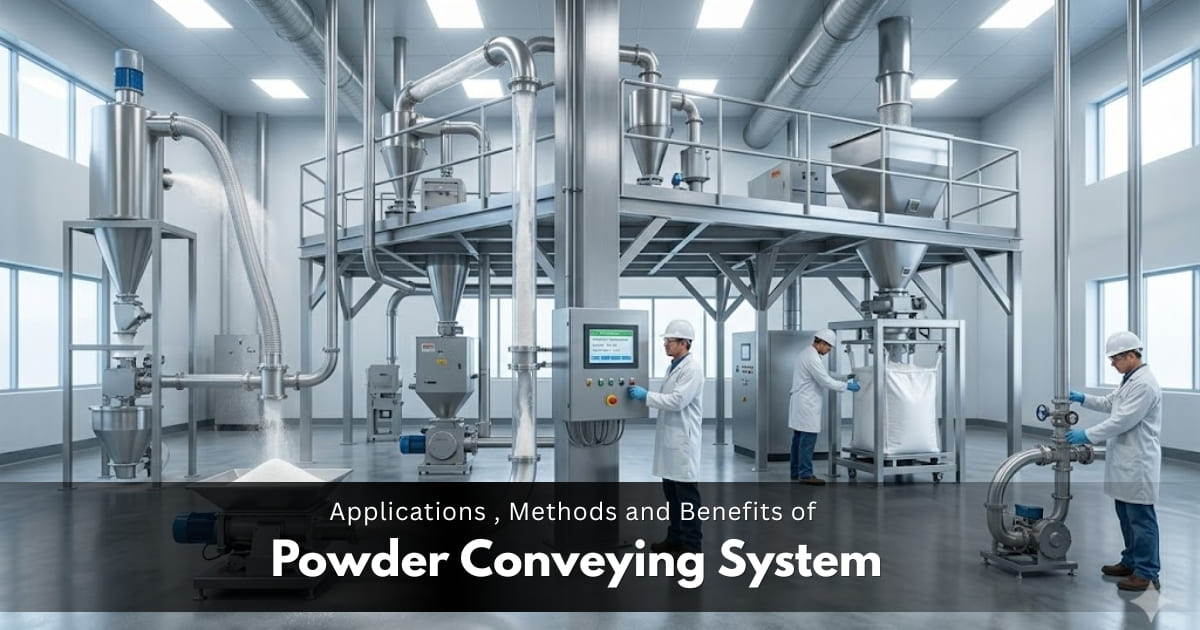
In industries handling fine materials, inefficiencies in powder transfer often lead to dust loss, contamination, and inconsistent flow, directly impacting productivity and product quality. As manufacturing processes become more automated and precision-driven, having a reliable powder conveying system is no longer optional-it’s essential.
Modern facilities increasingly rely on engineered solutions from companies like Orchid Material Handling Solutions to ensure controlled, dust-free, and efficient movement of powders across different stages of production.
What is a Powder Conveying System?
A powder conveying system is an automated setup designed to transfer powders and granules within a plant using mechanical or pneumatic methods, ensuring minimal loss, contamination-free handling, and consistent material flow.
Key Applications Across Industries
Powder conveying systems are widely used in industries where precision, hygiene, and safety are critical to operations.
Food & Beverage Industry
Ingredients like flour, sugar, spices, and milk powder require strict hygiene standards. Enclosed conveying systems help maintain clean, contamination-free processes while reducing manual intervention.
Pharmaceutical Industry
Even minor contamination can affect product integrity. These systems enable dust-free transfer of active ingredients and excipients, supporting compliance with stringent quality standards.
Chemical Industry
Handling reactive or hazardous powders demands controlled environments. Powder conveying systems ensure safe and enclosed material movement, minimizing exposure risks.
Plastics & Polymers
Used for transporting resin powders and granules, these systems support continuous production and seamless integration with molding and extrusion processes.
Fertilizers & Bulk Processing
For large-scale operations, conveying systems enable efficient handling of bulk powders like urea and minerals, improving throughput and reducing wastage.
Methods of Powder Conveying Used in Modern Plants
Different conveying methods are selected based on material characteristics, distance, plant layout, and hygiene requirements.
Pneumatic Conveying Systems
Pneumatic conveying uses air pressure or vacuum to move powders through pipelines, making it suitable for long-distance and enclosed transfer.
- Best suited for fine and lightweight powders
- Ensures sealed, dust-free conveying
- Adapts well to complex plant layouts
Screw Conveyors
Screw conveyors use a rotating helical screw to move material along a fixed path, typically for short-distance and controlled feeding applications.
- Ideal for measured and consistent flow
- Simple and cost-effective
- Suitable for semi-cohesive powders
Tube Chain Conveyors (Drag Conveyors)
Tube chain conveyors transport powders through an enclosed pipe using discs attached to a chain, offering highly controlled and hygienic conveying.
- Preferred in food and pharmaceutical industries
- Gentle handling minimizes material degradation
- Supports multi-directional conveying
Bucket Elevators
Bucket elevators are designed for vertical lifting of powders and bulk materials, especially in high-capacity operations.
- Suitable for dense and heavy materials
- Efficient vertical transport
- Widely used in bulk processing industries
Quick Comparison: Selecting the Right Method
| Requirement | Best-Suited System |
| Long-distance, enclosed transfer | Pneumatic Conveying |
| Hygienic, dust-free handling | Tube Chain Conveyor |
| Controlled, short-distance feeding | Screw Conveyor |
| High-capacity vertical lifting | Bucket Elevator |
Key Benefits of a Powder Conveying System
A well-designed system delivers measurable improvements across operations, safety, and cost efficiency.
Operational Efficiency
Automated conveying ensures consistent material flow, reduced downtime, and faster production cycles, minimizing reliance on manual handling.
Hygiene & Contamination Control
Enclosed systems eliminate dust exposure, making them essential for industries where product purity and compliance are critical.
Reduced Material Loss
By preventing spillage and airborne loss, conveying systems improve overall yield and cost efficiency.
Enhanced Workplace Safety
Minimizing direct handling reduces risks associated with inhalation, exposure, and workplace hazards.
Flexible & Scalable Design
Modern systems can be adapted to evolving plant layouts, enabling easy expansion and seamless integration with other equipment.
How to Choose the Right Powder Conveying System
Selecting the right system depends on your process requirements and material characteristics:
- For hygienic and dust-free applications → Tube Chain Conveyor
- For long-distance and flexible routing → Pneumatic Conveying
- For controlled feeding and short distances → Screw Conveyor
- For bulk vertical transport → Bucket Elevator
In many advanced facilities, combining multiple systems results in better efficiency and process optimization across different stages.
Final Thoughts
A powder conveying system plays a critical role in ensuring process efficiency, product quality, and operational safety. The right selection not only improves material handling but also enhances overall plant performance.
With increasing focus on automation and precision, solutions offered by Orchid Material Handling Solutions are designed to align with diverse industrial requirements-whether it’s ensuring dust-free handling, optimizing flow, or integrating multiple conveying systems into a single streamlined process.
You can connect with us for your queries. Mail id – sales@orchidmhs.com | Website – https://www.orchidmaterialhandling.com/contact-us/ | contact no. +91 9322487698 | Social– facebook, linkedin
FAQs
It is used to transfer powders and granules efficiently within a plant while maintaining dust-free and contamination-free conditions.
The choice depends on application needs-pneumatic systems are ideal for long distances, while tube chain conveyors are preferred for hygienic handling.
Pneumatic conveying is suitable for enclosed, long-distance transfer, whereas screw conveyors are better for controlled, short-distance applications.
Industries such as food processing, pharmaceuticals, chemicals, plastics, and fertilizers widely use these systems.
By automating material transfer, reducing manual handling, and minimizing material loss, it ensures consistent and efficient production processes.