- sales@orchidmhs.com
- +91 9322487698
- +91 7028807698
- ISO 9001:2015


What is the Difference Between Dense Phase and Dilute Phase Conveying?
02 Aug 2026
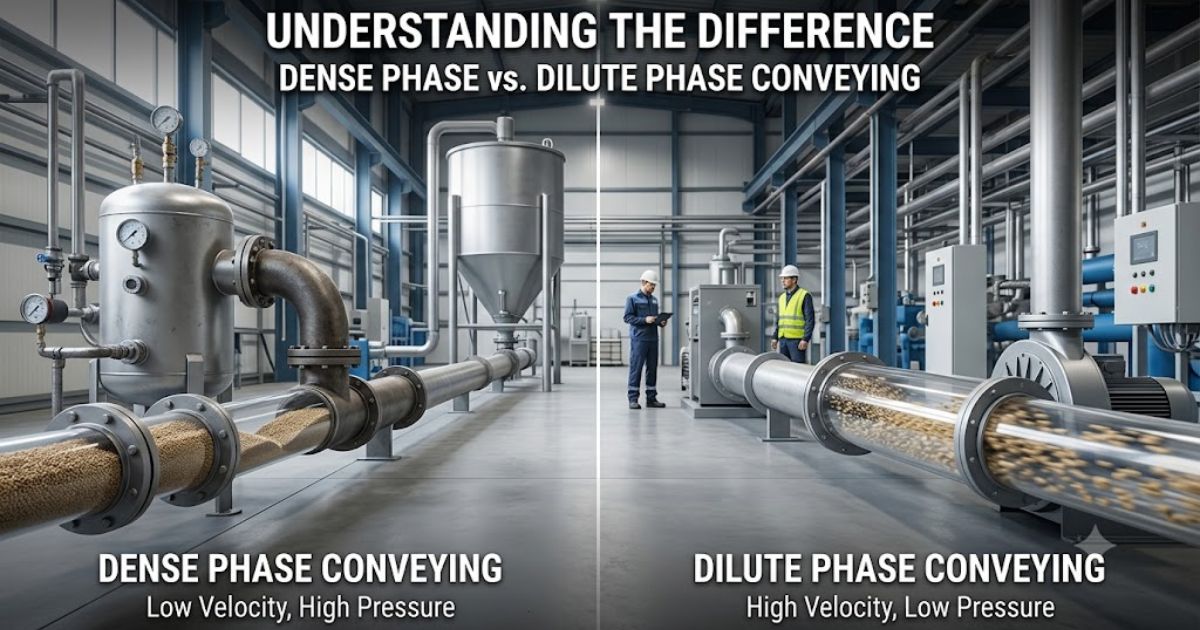
Selecting the right pneumatic conveying system is one of the most important decisions in any bulk material handling process. While both Dense Phase and Dilute Phase Conveying are designed to transport powders, granules, and bulk solids using air pressure, they operate differently and are suited for different industrial applications.
Choosing the wrong conveying method can result in excessive product degradation, pipeline wear, increased energy consumption, and unnecessary maintenance costs. On the other hand, selecting the right system improves material flow, protects product quality, and enhances production efficiency.
At Orchid Material Handling Solutions, we help manufacturers choose the right Pneumatic Conveying System by evaluating material characteristics, conveying distance, plant layout, and production capacity. Rather than offering a standard solution, every system is engineered to match the customer’s process requirements.
Understanding Dense Phase and Dilute Phase Conveying
Both Dense Phase and Dilute Phase are types of Pneumatic Conveying Systems that transport materials through enclosed pipelines using compressed air. However, the way the material moves inside the pipeline is completely different.
Dense Phase Conveying transports material at a lower air velocity using higher pressure. The material moves in compact plugs or slugs, making it ideal for fragile or abrasive products.
Dilute Phase Conveying, on the other hand, uses higher air velocity and lower pressure to keep the material fully suspended throughout the pipeline. This makes it suitable for free-flowing materials and applications requiring faster conveying rates.
Understanding these differences is essential for selecting the most efficient conveying solution.
Dense Phase vs Dilute Phase Conveying: Key Differences
| Parameter | Dense Phase Conveying | Dilute Phase Conveying |
| Air Velocity | Low | High |
| Operating Pressure | High | Low to Medium |
| Material Movement | Material moves in plugs or slugs | Material remains suspended in airflow |
| Product Handling | Gentle | Faster but comparatively aggressive |
| Material Degradation | Very Low | Moderate (depends on product) |
| Pipeline Wear | Lower | Higher |
| Energy Consumption | Lower for suitable applications | Higher due to increased airflow |
| Best For | Fragile & abrasive materials | Free-flowing powders & granules |
| Conveying Distance | Medium to Long | Short to Medium |
When Should You Choose Dense Phase Conveying?
Dense Phase Conveying is recommended when maintaining product quality is more important than conveying speed.
It is commonly used for:
- Coffee beans
- Plastic pellets
- Pharmaceutical powders
- Food ingredients
- Specialty chemicals
- Fragile bulk materials
Advantages of Dense Phase Conveying
- Minimal product degradation
- Lower pipeline wear
- Reduced dust generation
- Lower air consumption
- Better handling of abrasive materials
- Suitable for longer conveying distances
However, Dense Phase systems generally involve a higher initial investment and require more specialized system design.
When Should You Choose Dilute Phase Conveying?
Dilute Phase Conveying is the preferred choice when materials need to be transferred quickly and continuously.
Typical applications include:
- Cement
- Fly ash
- Lime
- Flour
- Sugar
- Mineral powders
- Plastic granules
Advantages of Dilute Phase Conveying
- Higher conveying speed
- Simpler system design
- Lower installation cost
- Continuous material transfer
- Suitable for a wide range of free-flowing materials
Because materials travel at higher velocities, these systems may experience increased pipe wear and product degradation when handling delicate materials.
Factors to Consider Before Choosing the Right Conveying System
Selecting between Dense Phase and Dilute Phase Conveying depends on several engineering factors rather than cost alone.
Material Characteristics
Bulk density, particle size, abrasiveness, moisture content, and flowability all influence the ideal conveying method.
Product Sensitivity
Fragile materials generally benefit from Dense Phase Conveying, while robust materials can often be handled efficiently using Dilute Phase systems.
Conveying Distance
Longer conveying distances may require different system configurations depending on material properties and production requirements.
Production Capacity
The required throughput plays an important role in selecting the appropriate conveying technology.
Plant Layout
Available installation space, pipeline routing, and future expansion plans should also be considered during system design.
Which Industries Use Dense Phase and Dilute Phase Conveying?
Both technologies are widely used across industries, but the choice depends on the application.
| Industry | Preferred Conveying Method |
| Pharmaceuticals | Dense Phase |
| Food Processing | Dense Phase |
| Nutraceuticals | Dense Phase |
| Chemicals | Dense or Dilute (depending on material) |
| Plastics | Dense Phase |
| Cement | Dilute Phase |
| Mining & Minerals | Dilute Phase |
| Fertilizers | Dilute Phase |
In many manufacturing facilities, both systems may be used for different materials within the same production line.
Which Pneumatic Conveying System is Better?
There is no universal answer.
A Dense Phase Conveying System is not automatically better than a Dilute Phase Conveying System—or vice versa. The right choice depends entirely on the material being conveyed and the operational requirements.
If your priority is protecting fragile materials and reducing pipeline wear, Dense Phase Conveying is often the preferred solution.
If your focus is achieving higher conveying rates with relatively free-flowing materials, Dilute Phase Conveying is usually the more practical option.
The best-performing systems are those designed specifically for the application rather than selected based on general assumptions.
How Orchid Material Handling Solutions Helps You Choose the Right System
At Orchid Material Handling Solutions, we believe that every bulk material handling application is unique. Before recommending a Dense Phase or Dilute Phase Pneumatic Conveying System, our engineering team evaluates material characteristics, conveying distance, throughput requirements, plant layout, and future production plans.
We also integrate Pneumatic Conveying Systems with Bulk Storage Systems, Industrial Mixers, Weighing & Batching Systems, Powder Handling Accessories, Dust Air Filtration Systems, Bag Filling Systems, and Industrial Control Panels to create complete, automated material handling solutions.
This engineering-first approach helps manufacturers improve efficiency, reduce maintenance, and maximize long-term system performance.
Frequently Asked Questions
Dense Phase Conveying moves materials at low air velocity and high pressure, while Dilute Phase Conveying uses high air velocity and lower pressure to keep materials suspended throughout the pipeline.
Dense Phase Conveying is generally preferred because it minimizes product degradation and pipeline wear.
Dilute Phase systems often have a lower initial installation cost, making them suitable for many standard industrial applications. However, long-term operating costs depend on the material and production process.
Yes. Orchid Material Handling Solutions designs customized Dense Phase and Dilute Phase Pneumatic Conveying Systems based on material characteristics, production capacity, and plant layout to ensure optimum performance.
The ideal solution depends on factors such as material properties, conveying distance, throughput, and operational goals. Orchid’s engineering team evaluates these parameters to recommend the most suitable pneumatic conveying solution for your facility.