- sales@orchidmhs.com
- +91 9322487698
- +91 7028807698
- ISO 9001:2015


Step-by-Step Guide to Milk Powder Production & Raw Material Handling
14 Oct 2026
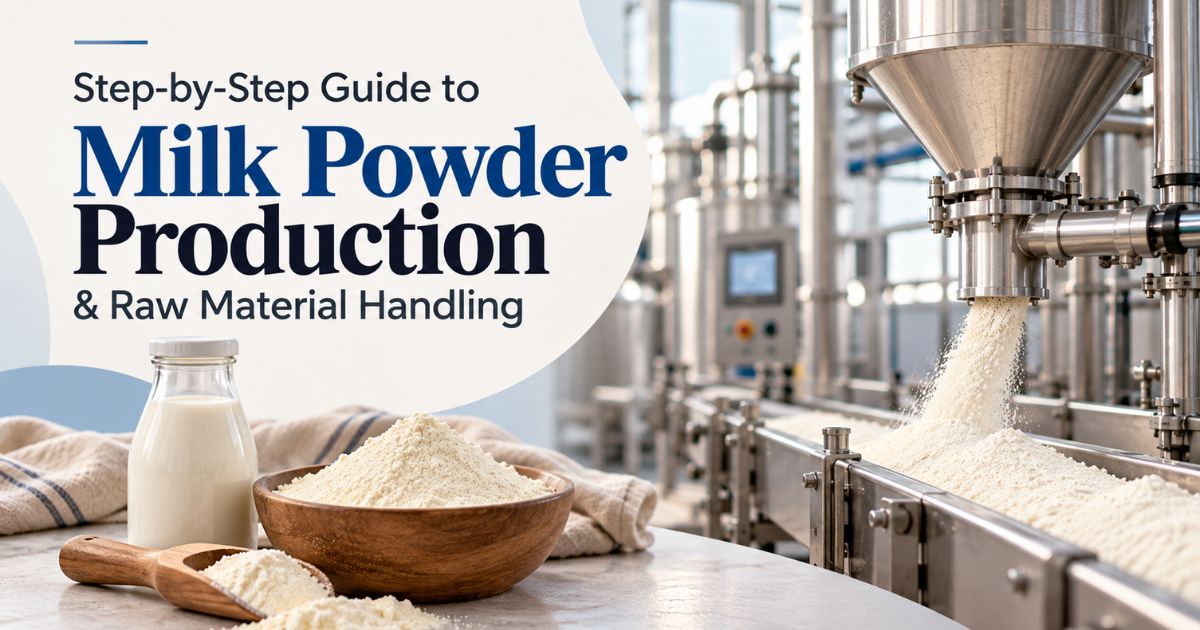
Orchid Material Handling Solutions designs and manufactures powder and bulk material handling systems for food and dairy processing applications, helping manufacturers manage dry ingredients through controlled unloading, conveying, storage, blending, weighing and filling. In milk powder manufacturing, these operations are particularly important because the finished powder must be handled carefully to protect its quality, maintain hygiene and support consistent production.
Milk powder is produced by removing most of the water from liquid milk through a controlled sequence of processing operations. The main stages include milk reception, clarification, standardization, pasteurization, evaporation, spray drying, cooling, powder handling and packaging. Each stage contributes to the quality, stability and functional properties of the finished product.
However, producing milk powder is only part of the process. Once the milk has been dried, manufacturers must also manage powder flow, moisture exposure, dust generation, storage conditions and transfer between equipment. This is where properly engineered material handling systems become essential.
In this guide, we explain how milk powder is manufactured, which equipment is used at each stage and how hygienic powder handling supports efficient dairy production.
What Is Milk Powder and How Is It Manufactured?
Milk powder is a dairy product manufactured by removing water from liquid milk to produce a dry, concentrated product. It is commonly used in food processing, bakery products, confectionery, beverages, nutritional formulations and other dairy applications.
Commercial milk powder production generally involves preparing and concentrating liquid milk before converting it into powder through spray drying. The dried product is then cooled, handled, stored and packaged under controlled conditions.
The typical manufacturing sequence is:
Milk Reception → Clarification → Standardization → Pasteurization → Evaporation → Spray Drying → Powder Cooling → Conveying → Storage → Packaging
Additional stages such as agglomeration, instantization, blending or sieving may be included depending on the product specification.
Step-by-Step Milk Powder Production Process
Step 1: Raw Milk Reception and Quality Inspection
Milk powder manufacturing begins with receiving raw milk at the dairy processing facility. Before processing, the milk is checked against the plant’s quality requirements, which may include temperature, composition, acidity, microbiological quality and other relevant parameters.
Milk is transferred into appropriate receiving and storage systems under controlled conditions. Maintaining suitable handling temperatures and minimizing unnecessary exposure are important because raw milk is a perishable material.
At this stage, hygienic pumps, pipelines, receiving tanks and storage equipment support controlled liquid milk movement.
Step 2: Milk Clarification and Separation
After reception, milk undergoes clarification to remove unwanted physical impurities and sediment. Depending on the production process, centrifugal separators may also be used to separate cream from skim milk.
This stage helps prepare the milk for subsequent standardization and thermal processing. Properly maintained clarification and separation equipment supports consistent processing conditions and reduces the likelihood of unwanted material entering downstream equipment.
Step 3: Milk Standardization
Standardization adjusts the composition of the milk to meet the required product specification. For example, whole milk powder and skimmed milk powder have different fat-content requirements, so the milk composition must be controlled before drying.
The dairy plant adjusts the proportion of cream and skim milk according to the intended finished product. Accurate measurement and process control are important because variations at this stage can affect the composition of the final milk powder.
Step 4: Pasteurization and Heat Treatment
Pasteurization applies controlled heat treatment to reduce relevant microbial hazards and prepare the milk for further processing. The required temperature and holding time depend on the product, process design and applicable food safety requirements.
Heat treatment also influences the functional properties of milk proteins, making the selected conditions important for different milk powder applications.
The equipment used typically includes heat exchangers, holding arrangements, pumps and automated temperature controls.
Step 5: Evaporation and Milk Concentration
Before spray drying, much of the water is removed from the milk through evaporation. This produces concentrated milk with a substantially higher solids content than the original liquid.
Industrial dairy plants commonly use vacuum evaporation systems because operating under reduced pressure allows water removal at lower temperatures than would otherwise be required.
Concentrating the milk before spray drying reduces the amount of water that the dryer must remove, improving the overall efficiency of the drying process.
The required concentration depends on the milk powder formulation and the operating requirements of the drying system.
Step 6: Spray Drying
Spray drying is the central operation in most industrial milk powder production processes. Concentrated milk is atomized into fine droplets inside a drying chamber, where controlled contact with heated air removes moisture and forms dry milk particles.
The droplets dry rapidly because atomization creates a large surface area for heat and mass transfer. The resulting powder is separated from the drying air using suitable collection equipment.
Spray drying conditions influence several finished-product characteristics, including moisture content, particle structure, bulk density, solubility and flowability.
The drying process must therefore be controlled according to the intended milk powder specification rather than simply maximizing drying temperature or throughput.
Step 7: Powder Cooling and Conditioning
Freshly dried milk powder may require additional drying or cooling before entering downstream handling and packaging equipment. Many industrial spray-drying lines use integrated or external fluidized-bed systems to complete these operations.
Cooling helps prepare the powder for subsequent processing and packaging. Appropriate control of powder temperature and surrounding air conditions is important because moisture uptake can contribute to caking, agglomeration and reduced flowability.
Depending on the product, additional processing such as agglomeration or instantization may be carried out to achieve specific reconstitution or handling characteristics.
Step 8: Milk Powder Conveying and Transfer
Once milk powder has been produced and conditioned, it must be transferred between processing equipment, storage vessels, blending systems and packaging lines.
This stage requires particular attention because milk powder can generate airborne dust, absorb moisture and experience changes in particle characteristics during handling.
Orchid Material Handling Solutions offers enclosed powder handling technologies, including Powder Transfer Systems, Pneumatic Conveying Systems and Mechanical Conveyors, which can be evaluated for appropriate dry dairy powder applications.
The conveying method should be selected according to powder bulk density, particle size, flowability, required capacity, conveying distance and sensitivity to particle damage.
For example, a pneumatic conveying system may be suitable where enclosed transfer and flexible pipeline routing are important, while a mechanical conveyor may be appropriate for specific controlled transfer requirements.
Step 9: Milk Powder Storage
After drying, milk powder may be transferred into intermediate storage before blending or packaging. Storage systems should be designed to limit unwanted moisture exposure, support hygienic operation and allow controlled powder discharge.
Depending on production capacity and plant configuration, manufacturers may use silos, bins, hoppers or Intermediate Bulk Containers (IBCs).
Orchid provides Silo Storage Systems and IBC Storage & Handling Systems that can be configured around bulk powder storage and discharge requirements.
Where powders are prone to bridging, rat-holing or inconsistent discharge, appropriately selected flow-assistance equipment may also be considered. However, the need for a bin activator or another flow aid should be determined from the powder’s actual flow characteristics.
Step 10: Blending and Ingredient Addition
Some milk powder products require additional ingredients or controlled blending after drying. This may include nutritional formulations, dairy-based beverage powders or other specialized food products.
Accurate weighing and consistent mixing become important when multiple ingredients must be combined to meet a defined formulation.
Orchid’s Weighing & Batching Systems, Ribbon Blenders, Paddle Mixers and other mixing solutions can be evaluated for appropriate dry ingredient applications.
The mixing technology should be selected according to ingredient properties, batch size, mixing requirements and the sensitivity of the powder to mechanical handling.
Step 11: Milk Powder Filling and Packaging
The final stage involves transferring the finished milk powder into suitable packaging while protecting it from moisture, contamination and unnecessary exposure.
Depending on the application, milk powder may be packed into industrial bags, bulk bags or consumer packaging through dedicated packaging equipment.
For bulk packaging operations, Orchid’s Small Bag Filling Machines, Valve Bag Filling Machines and Jumbo Bag Filling Machines may be considered where the powder characteristics and packaging format are suitable.
Filling equipment can be integrated with weighing systems, dust extraction and automation to support controlled material discharge and packaging accuracy.
Equipment Used in Milk Powder Manufacturing
Milk powder production requires both dairy-processing machinery and dry powder handling equipment. Understanding this distinction helps manufacturers select the right equipment for each stage.
| Production Stage | Equipment Used | Primary Function |
| Milk reception | Receiving tanks, pumps, filters | Raw milk intake and transfer |
| Clarification | Clarifiers and separators | Removal of impurities and cream separation |
| Standardization | Dosing and process-control equipment | Milk composition adjustment |
| Pasteurization | Heat exchangers and holding systems | Controlled heat treatment |
| Evaporation | Vacuum evaporators | Water removal and concentration |
| Spray drying | Spray dryer and powder separation equipment | Conversion into dry powder |
| Cooling | Fluidized-bed cooler or conditioning system | Powder cooling and conditioning |
| Powder transfer | Pneumatic / mechanical conveying systems | Movement of dry powder |
| Storage | Silos, bins and IBC systems | Intermediate powder storage |
| Blending | Mixers, blenders and batching systems | Ingredient mixing |
| Packaging | Weighing and filling equipment | Controlled powder filling |
The first six stages primarily involve liquid dairy processing and drying technologies. Orchid’s material handling solutions are particularly relevant after drying, when the product needs to be conveyed, stored, blended and filled.
Why Is Raw Material Handling Important in Milk Powder Production?
Raw material handling has a direct influence on production efficiency, material losses, hygiene and product consistency. In milk powder plants, handling requirements also change considerably as the material moves from liquid milk to concentrated milk and finally to dry powder.
Liquid milk handling depends on sanitary pumps, pipelines and processing vessels, whereas dry milk powder handling requires equipment that can manage bulk solids without introducing unnecessary moisture, contamination or particle damage.
Poorly designed powder transfer arrangements can create several operational challenges, including dust generation, inconsistent feeding, material buildup and additional cleaning requirements. Integrating suitable conveying, storage and feeding equipment helps manufacturers manage these challenges as part of the overall production process.
Key Challenges in Milk Powder Handling
Moisture Absorption and Caking
Milk powder can absorb moisture from its surroundings, particularly when exposed to humid air. Depending on its composition and storage conditions, moisture uptake may contribute to caking, reduced flowability and changes in product quality.
To manage these risks, manufacturers should consider enclosed handling arrangements, suitable environmental controls, appropriate packaging and storage conditions matched to the product specification.
Dust Generation and Containment
Powder transfer, filling and discharge operations can generate airborne dust. This creates housekeeping and product-loss concerns and, under certain conditions, combustible-dust hazards.
Enclosed conveying systems, suitable dust extraction and properly designed transfer connections can help control powder release. Facilities should also assess combustible-dust risks and implement appropriate equipment, ignition-source controls and explosion-protection measures where required.
Powder Flow Problems
Some milk powders can develop flow difficulties depending on particle size, moisture content, consolidation and storage conditions. Problems may include bridging, rat-holing and inconsistent discharge from hoppers or silos.
These issues can affect downstream feeding and packaging accuracy. Correct vessel geometry, discharge design and application-specific flow aids may help maintain consistent movement.
Particle Damage During Conveying
Milk powder particle characteristics can affect bulk density, handling performance and reconstitution properties. Excessive mechanical stress during conveying may damage fragile agglomerates or increase the proportion of fine particles.
For this reason, conveying velocity, transfer points, bends and equipment configuration should be evaluated against the powder’s characteristics.
Hygiene and Cleaning
Food and dairy powder handling equipment must support appropriate cleaning and sanitation practices. Poorly accessible areas, material-retention points and unsuitable construction can make cleaning more difficult.
Equipment selection should therefore consider product-contact materials, hygienic design, accessibility, sealing and the cleaning procedures used by the facility.
How to Select the Right Milk Powder Handling System
Selecting a powder handling system should begin with the material and operating requirements rather than choosing equipment based only on conveying capacity.
- Powder characteristics: Evaluate bulk density, particle size, moisture sensitivity, flowability, fat content, cohesiveness and particle fragility. These factors influence the suitability of pneumatic or mechanical conveying, storage and feeding arrangements.
- Production capacity: Determine the required throughput, batch size and operating hours. The system should support the plant’s actual production requirements without unnecessary oversizing.
- Conveying distance and layout: Horizontal distance, vertical lift, bends, pickup points and discharge locations influence equipment selection and system performance.
- Hygiene and cleaning: Product-contact construction, surface finish, sealing arrangements, cleaning accessibility and sanitation requirements should be established before finalizing equipment specifications.
- Dust and environmental controls: Evaluate powder containment, dust collection, humidity management and combustible-dust safety requirements.
- Process integration: Consider how the conveying equipment will connect with the spray dryer discharge, storage system, mixer, weighing equipment or packaging line.
An integrated engineering assessment can help ensure that individual machines operate as part of a coordinated milk powder handling process.
How Orchid Supports Milk Powder Handling Operations
Orchid Material Handling Solutions provides engineered powder and bulk material handling equipment that can support suitable dry dairy and food-processing applications. Rather than focusing only on a single machine, Orchid’s portfolio allows manufacturers to evaluate the movement of material across multiple production stages.
Relevant equipment includes:
- Powder Transfer Systems: For enclosed powder transfer between suitable process equipment and containers.
- Pneumatic Conveying Systems: For transporting powders and granules through enclosed pipelines.
- Screw Conveyors and Mechanical Conveyors: For controlled mechanical movement of suitable bulk materials.
- Silo Storage and IBC Handling Systems: For intermediate storage and controlled discharge.
- Weighing & Batching Systems: For accurate ingredient measurement and addition.
- Mixers & Blenders: For dry ingredient blending where the equipment matches the product requirements.
- Dust & Air Filtration Systems: For dust collection at relevant transfer, storage and filling points.
- Bag Filling Systems: For controlled bulk powder packaging.
- PLC & HMI-Based Control Panels: For equipment sequencing, monitoring and automation.
For example, a dry powder handling section may be configured as:
Powder Collection → Enclosed Conveying → Intermediate Storage → Weighing / Blending → Filling & Packaging
The actual configuration depends on the milk powder’s properties, required throughput, hygiene standards and existing dairy processing equipment.
How Automation Improves Milk Powder Handling Efficiency
Automation can improve coordination between powder conveying, storage, batching and filling operations. Instead of relying on operators to manually start and stop equipment at every stage, appropriately designed control systems can manage process sequences according to operating requirements.
PLC and HMI-based systems can support equipment interlocks, level monitoring, weighing operations, alarms and controlled material transfer. When integrated correctly, automation can reduce unnecessary manual intervention and improve process repeatability.
However, automation should complement appropriate equipment design and hygiene procedures rather than replace them. Reliable powder flow, suitable conveying conditions and effective cleaning remain essential to the overall performance of the system.
Frequently Asked Questions
Milk powder is generally manufactured through milk reception, clarification, standardization, pasteurization, evaporation, spray drying, powder cooling, conveying, storage and packaging. Additional blending or instantization stages may be included depending on the finished product.
The main dairy-processing equipment includes separators, pasteurizers, evaporators and spray dryers. Dry powder handling equipment can include pneumatic conveyors, screw conveyors, silos, IBC systems, mixers, weighing systems, dust collectors and filling machines.
Spray drying converts concentrated liquid milk into dry particles by atomizing it into a controlled stream of heated air. The process supports continuous industrial production and allows manufacturers to control important powder properties through the drying conditions.
Yes. Pneumatic conveying can be used for suitable milk powder applications, provided the system is engineered around the powder’s particle characteristics, moisture sensitivity, required capacity and handling requirements. Conveying conditions should be selected carefully to limit unwanted particle damage and product buildup.
Caking risk can be reduced by controlling moisture exposure, maintaining appropriate powder and storage conditions, using suitable packaging and designing storage and discharge equipment around the material’s flow characteristics. The appropriate measures depend on the product formulation and operating environment.
Milk powder can be stored in suitably designed silos, bins, hoppers or IBCs, depending on production capacity and process requirements. Storage systems should support hygienic operation, controlled discharge and protection from unwanted moisture exposure.
Dust control helps reduce airborne powder, product loss and housekeeping requirements. Because suspended milk powder dust may also present combustible-dust hazards under certain conditions, appropriate dust collection and safety measures should be determined through a facility-specific risk assessment.
Mixers and blenders are used when dry milk powder must be combined with other ingredients or formulated into a specific product. The mixing system should provide the required blend consistency without unnecessarily damaging the powder.
Orchid provides powder handling equipment such as Pneumatic Conveying Systems, Powder Transfer Systems, Mechanical Conveyors, Silo and IBC Storage Systems, Weighing & Batching Systems, Mixers, Dust Collection Systems and Filling Equipment. These solutions can be configured for suitable dry dairy powder handling operations.
Conclusion
Milk powder manufacturing is a multi-stage process that begins with liquid milk preparation and ends with controlled handling and packaging of the dried product. While clarification, pasteurization, evaporation and spray drying are responsible for producing the powder, the subsequent handling stages are equally important for maintaining product quality and production efficiency.
Conveying, storage, blending, weighing, dust control and filling should be designed around the milk powder’s characteristics, particularly its sensitivity to moisture, flow behavior and potential particle damage.
Orchid Material Handling Solutions supports suitable dairy and food powder applications through engineered material handling systems designed around controlled powder movement, process integration and operational requirements.
Looking for a reliable material handling system for milk powder or dairy ingredients?
Connect with Orchid Material Handling Solutions to discuss your powder characteristics, required throughput, conveying distance, storage configuration, hygiene requirements and packaging needs.