- sales@orchidmhs.com
- +91 9322487698
- +91 7028807698
- ISO 9001:2015


Pipe Conveyor Belt vs Traditional Conveyors
29 Jan 2026
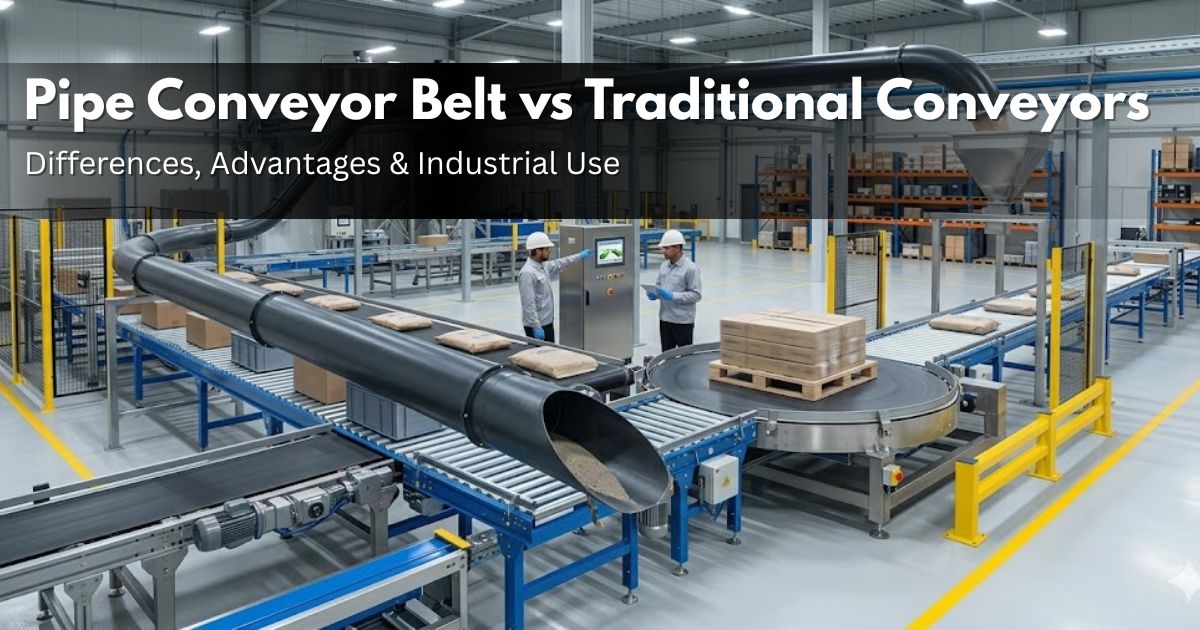
Differences, Advantages, Limitations and Industrial Use Cases
In bulk material handling industries, conveyor selection is no longer a straightforward engineering choice. It directly impacts environmental compliance, operational efficiency, maintenance costs, and long-term scalability. As industries deal with dust-sensitive materials, complex layouts, and stricter regulations, the comparison between pipe conveyor belts and traditional conveyor systems has become increasingly relevant.
This guide is written to help plant owners, project consultants, and operations teams clearly understand how these two conveyor technologies differ, where each one fits best, and how to make the right decision based on real industrial conditions rather than generic specifications.
1. Why Conveyor Selection Has Become a Strategic Decision
Earlier, conveyor systems were selected mainly based on capacity and distance. Today, industries must also consider:
- Dust and emission control
- Space availability and routing complexity
- Material loss and housekeeping effort
- Safety and regulatory compliance
- Long-term operating and maintenance costs
Traditional conveyors still dominate many applications, but pipe conveyor belts have emerged specifically to address limitations that traditional systems face in modern plants.
2. Core Design Philosophy Comparison
Understanding the intent behind each system explains most of their differences.
Design Intent Overview
| Aspect | Pipe Conveyor Belt | Traditional Conveyor |
| Material transport | Fully enclosed | Open or semi-open |
| Exposure to environment | None | High |
| Direction change | Curves without transfer | Requires transfer points |
| Dust containment | Inherent | External systems required |
| Typical usage | Bulk, dusty materials | General material handling |
Pipe conveyors are designed for containment-first transport, while traditional conveyors are designed for simplicity and accessibility.
3. How Material Behavior Differs Inside Each System
Material behavior during conveying is often underestimated, yet it directly affects efficiency and maintenance.
Material Handling Behavior Comparison
| Parameter | Pipe Conveyor Belt | Traditional Conveyor |
| Dust generation | Very low | High for fine materials |
| Spillage risk | Minimal | Moderate to high |
| Weather impact | None | Significant for outdoor systems |
| Material degradation | Low | Higher at transfer points |
For fine powders such as cement, fly ash, or chemicals, this difference alone can justify the use of a pipe conveyor belt.
4. Layout Flexibility and Space Optimization
Traditional Conveyor Layout Reality
Traditional conveyors require:
- Straight runs
- Transfer towers for every direction change
- Additional structures for covers and dust control
As the layout becomes complex, the system grows larger and harder to manage.
Pipe Conveyor Layout Advantage
Pipe conveyor belts allow:
- Horizontal curves
- Vertical curves
- Routing around buildings, roads, and equipment
- Long-distance conveying with minimal footprint
This makes pipe conveyors highly suitable for brownfield plants and space-constrained facilities.
Layout Capability Comparison
| Feature | Pipe Conveyor Belt | Traditional Conveyor |
| Horizontal curves | Yes | Limited |
| Vertical curves | Yes | No |
| Transfer points needed | Minimal | Multiple |
| Space efficiency | High | Moderate to low |
5. Transfer Points and Their Operational Impact
Transfer points are one of the biggest contributors to downtime and maintenance costs.
Transfer Point Impact Comparison
| Factor | Pipe Conveyor Belt | Traditional Conveyor |
| Number of transfer points | Very few | Multiple |
| Wear and tear | Low | High |
| Dust release | Minimal | Significant |
| Maintenance frequency | Lower | Higher |
Reducing transfer points improves system reliability and lowers long-term operational risk.
6. Energy Consumption and System-Level Efficiency
Pipe conveyors often appear less efficient when viewed in isolation due to belt overlap and higher resistance. However, this is misleading.
Energy Perspective Comparison
| Aspect | Pipe Conveyor Belt | Traditional Conveyor |
| Energy per meter | Higher | Lower |
| Auxiliary systems needed | Minimal | Dust collectors, covers |
| Overall system efficiency | High for long routes | Drops with complexity |
When evaluated at the system level, pipe conveyors often deliver better efficiency over long distances and complex layouts.
7. Maintenance and Operational Complexity
Maintenance Requirement Comparison
| Parameter | Pipe Conveyor Belt | Traditional Conveyor |
| Inspection | Planned and technical | Easy and visual |
| Skill requirement | Higher | Moderate |
| Breakdown points | Fewer | More |
| Maintenance frequency | Lower overall | Higher overall |
Pipe conveyors require trained maintenance teams, but their controlled design often results in fewer unplanned stoppages.
8. Safety and Environmental Compliance
Safety and compliance are no longer optional considerations.
Safety and Compliance Comparison
| Aspect | Pipe Conveyor Belt | Traditional Conveyor |
| Operator dust exposure | Very low | High |
| Housekeeping effort | Minimal | High |
| Environmental compliance | Easier | Requires additional systems |
| Spill-related accidents | Rare | More frequent |
For industries under strict environmental regulations, pipe conveyors offer a clear advantage.
9. Industry-Wise Application Mapping
Pipe Conveyor Belt Is Best Suited For
- Cement manufacturing
- Thermal power plants
- Mining and mineral processing
- Chemical and fertilizer industries
- Long-distance bulk material transport
Traditional Conveyor Is Best Suited For
- Packaging and warehousing
- Food processing with low-dust materials
- Assembly lines
- Short-distance conveying
- Cost-sensitive applications
10. Strategic Decision Framework
Instead of choosing based on cost alone, decision-makers should evaluate:
| Decision Parameter | Prefer Pipe Conveyor | Prefer Traditional Conveyor |
| Dust sensitivity | High | Low |
| Layout complexity | High | Low |
| Conveying distance | Long | Short |
| Environmental regulations | Strict | Moderate |
| Maintenance capability | Skilled teams | Basic teams |
Engineering-focused solution providers like Orchid Material Handling typically use this framework to design conveyor systems aligned with long-term operational goals rather than short-term savings.
Final Takeaway
Pipe conveyor belts and traditional conveyors are not competing technologies. They are solutions designed for different industrial realities.
Traditional conveyors remain reliable and economical for straightforward material handling tasks. Pipe conveyor belts exist to solve modern challenges related to dust control, space constraints, environmental compliance, and long-distance conveying.
When evaluated strategically, the right conveyor system improves not just material movement but overall plant efficiency, safety, and sustainability.