- sales@orchidmhs.com
- +91 9322487698
- +91 7028807698
- ISO 9001:2015

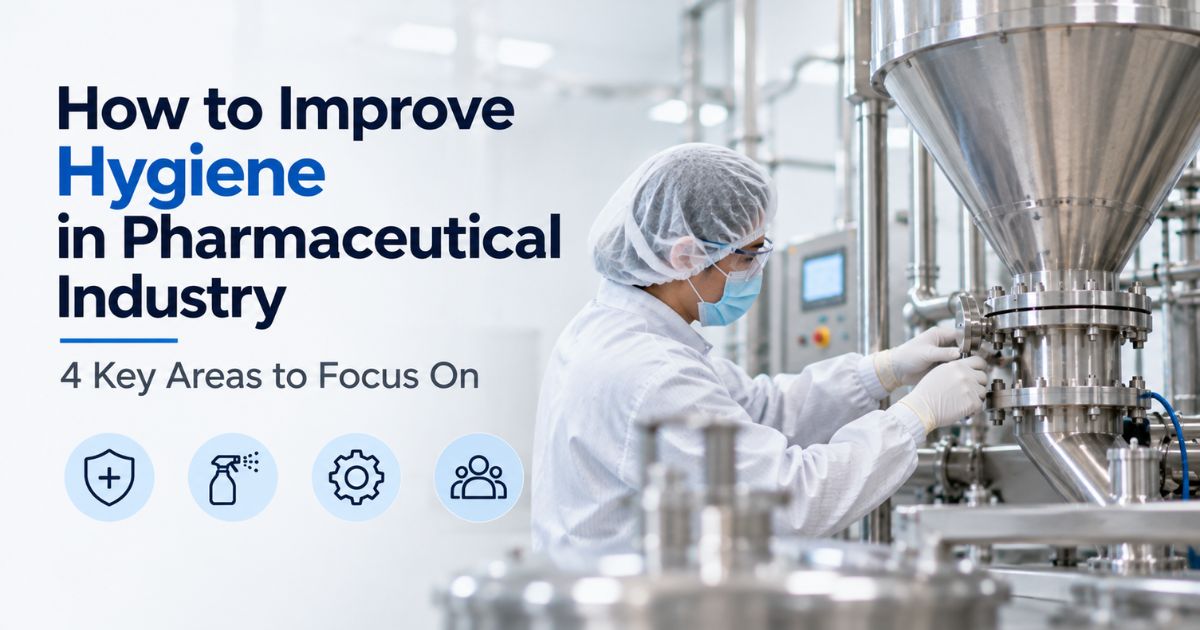
How to Improve Hygiene in Pharmaceutical Industry: 4 Key Areas to Focus On
13 Oct 2026
Orchid Material Handling Solutions designs hygienic material handling systems for pharmaceutical and nutraceutical manufacturing, helping manufacturers manage powders and bulk solids with better containment, controlled transfer and reduced risk of contamination. In pharmaceutical manufacturing, hygiene is not limited to cleaning the production floor or maintaining employee hygiene. The design of equipment, material transfer routes, storage systems, dust-control arrangements and cleaning procedures can all influence the overall hygiene of the manufacturing process.
Good Manufacturing Practices (GMP) are designed to minimize risks associated with pharmaceutical production, including contamination and cross-contamination. WHO guidance also emphasizes that premises and equipment should be designed to facilitate effective cleaning and maintenance, minimize dust and dirt buildup, and support logical movement of materials and personnel.
For pharmaceutical manufacturers handling powders, APIs, excipients and other bulk materials, four areas deserve particular attention: equipment and product-contact surfaces, dust and cross-contamination control, cleaning and maintainability, and process flow with automation and personnel practices.
Why Is Hygiene Important in the Pharmaceutical Industry?
Pharmaceutical products are highly sensitive to contamination because even small amounts of unwanted material can affect product quality, safety and consistency. Contamination can come from previous products, dust, airborne particles, cleaning residues, lubricants, equipment surfaces or inadequate handling practices.
This makes hygiene a process-wide responsibility rather than a task performed only after production. Equipment should be designed for the application, material transfer should be controlled, dust should be contained, and cleaning procedures should be practical and repeatable.
For facilities handling multiple products, the risk of cross-contamination becomes particularly important. Appropriate technical and organizational controls, including closed systems, suitable equipment design, cleaning procedures and validated cleaning approaches where applicable, can help manage these risks.
4 Key Areas to Improve Hygiene in Pharmaceutical Manufacturing
1. Use Hygienic Equipment and Suitable Product-Contact Materials
The first area to focus on is the equipment itself.
Material handling equipment comes into direct or indirect contact with pharmaceutical powders throughout processes such as unloading, conveying, storage, weighing, mixing and filling. If equipment surfaces are difficult to clean, have unsuitable geometries or allow material to accumulate, maintaining consistent hygiene becomes more difficult.
For pharmaceutical applications, manufacturers should consider factors such as:
- Product-contact material
- Surface finish
- Weld quality and accessibility
- Equipment geometry
- Crevices and material-retention points
- Ease of dismantling and inspection
- Cleaning accessibility
- Sealing arrangements
- Compatibility with the material and cleaning process
SS304 and SS316L are commonly considered for pharmaceutical equipment depending on the application and product-contact requirements. The appropriate grade and surface finish should be selected based on the actual process, material and cleaning requirements rather than assuming one specification is suitable for every application.
Orchid provides pharmaceutical material handling equipment in stainless-steel configurations, including SS304 and SS316L, across systems such as IBC Storage & Handling Systems, Powder Transfer Systems and other powder handling equipment.
For example, Orchid’s IBC Storage & Handling Systems are available in SS304/SS316L with polished internal surfaces and are designed for hygienic powder storage and transfer.
Why Equipment Design Matters
A hygienic material handling system should not simply use stainless steel. The complete equipment design should support cleaning, inspection and controlled material transfer.
A system with unsuitable joints, inaccessible areas or unnecessary material-retention points can remain difficult to clean even when the primary construction material is appropriate.
This is why hygiene should be considered during equipment selection and engineering rather than treated as a finishing step after installation.
2. Control Dust and Minimize Cross-Contamination
Dust control is one of the most important hygiene considerations when handling pharmaceutical powders.
Activities such as bag unloading, weighing, mixing, conveying and powder filling can generate airborne particles. If these particles are allowed to escape into the surrounding environment, they can increase operator exposure, create housekeeping issues and potentially contribute to cross-contamination.
WHO GMP guidance specifically identifies dust-generating operations such as sampling, weighing, mixing, processing and powder packaging as areas where measures should be taken to prevent cross-contamination and facilitate cleaning.
Use Enclosed Material Transfer Wherever Appropriate
One way to improve containment is to reduce unnecessary exposure of the material during transfer.
Instead of repeatedly opening containers and manually moving powders between process stages, pharmaceutical plants can consider enclosed systems such as:
- Powder Transfer Systems
- Pneumatic Conveying Systems
- Enclosed Screw Conveyors
- Sealed IBC discharge systems
- Dust-tight Bag Dischargers
- Closed storage and transfer arrangements
Orchid’s Powder Transfer Systems use vacuum-based transfer for enclosed movement of powders between process equipment and containers. Such systems can help reduce uncontrolled powder exposure during material transfer.
Improve Dust Extraction at Transfer Points
Dust can still be generated at specific points even when the overall process is automated.
Bag unloading stations, hopper charging points, filling equipment and other transfer locations may therefore require suitable dust extraction or filtration.
Orchid provides dust collection and filtration systems that can be integrated with bag unloading, silo, conveying and filling applications.
The objective is not simply to collect dust after it has spread through the production area. The system should be designed to capture airborne particles as close to the generation point as practical.
Reduce Cross-Contamination Risk
Cross-contamination can occur when residues from one material or product come into contact with another.
This becomes especially important in multi-product pharmaceutical facilities.
Controls may include:
- Closed material transfer
- Dedicated equipment where required
- Suitable cleaning procedures
- Controlled material and personnel movement
- Appropriate dust extraction
- Sealed connections
- Campaign-based production where applicable
- Equipment designed for effective cleaning
The exact controls should be determined through the facility’s contamination risk assessment and applicable GMP requirements.
3. Design Equipment for Easy Cleaning and Maintenance
A pharmaceutical material handling system is only as hygienic as its ability to be cleaned and maintained consistently.
Equipment should therefore be designed with cleaning and maintenance in mind from the beginning.
WHO GMP guidance states that premises and equipment should support effective cleaning and maintenance, while cleaning and disinfection should follow detailed written procedures with appropriate records.
Minimize Material Retention
Powder can accumulate in corners, dead zones, joints, filters, valves and other areas of a material handling system.
During equipment selection, manufacturers should evaluate where product could potentially remain after a batch has been discharged.
Reducing unnecessary retention points can make cleaning more effective and help reduce the possibility of residue carrying over into the next production cycle.
Make Inspection Easier
Equipment should allow operators and maintenance teams to inspect important product-contact and process areas.
Depending on the system, this may involve suitable access points, removable components, inspection arrangements or equipment configurations designed around the cleaning procedure.
Consider Cleaning Requirements Before Equipment Selection
Different pharmaceutical processes have different cleaning requirements.
Before selecting equipment, consider:
- Cleaning method
- Product characteristics
- Residue characteristics
- Batch changeover frequency
- Equipment accessibility
- Required dismantling
- Dry or wet cleaning requirements
- Cleaning validation requirements where applicable
For multi-product facilities, cleaning can become a critical part of contamination control. WHO guidance emphasizes the importance of cleaning procedures and cleaning validation in preventing contamination and cross-contamination where applicable.
Hygienic IBC Handling
IBC-based handling can also support a more controlled material flow by reducing repeated manual exposure of powders.
Orchid’s IBC systems are available in fixed and mobile configurations and can support controlled powder storage, transfer and discharge. The company’s IBC systems include SS304/SS316L construction, polished internal surfaces and dust-free discharge options.
4. Improve Material Flow, Automation and Personnel Practices
Hygiene is also influenced by how materials and people move through the manufacturing process.
A poorly planned material flow can result in unnecessary handling, repeated opening of containers and movement of materials through areas where exposure or cross-contamination risks are higher.
WHO GMP principles emphasize logical flow of materials and personnel within manufacturing premises.
Optimize Material Movement
A well-designed pharmaceutical material handling process should minimize unnecessary transfers.
For example:
Bag Unloading → Powder Transfer → Storage → Weighing → Mixing → Process Transfer → Filling
can be designed as an integrated material flow rather than a series of disconnected manual operations.
This can reduce the number of times operators need to manually open, transfer or reposition material.
Automate Critical Handling Steps
Automation can reduce manual intervention and improve process repeatability.
Depending on the application, PLC/HMI-based automation can control:
- Material transfer
- Weighing
- Batching
- Feeding
- Pneumatic conveying
- Mixing
- Filling
- Equipment interlocks
- Alarms
- Process sequences
Orchid provides PLC & HMI-based automation solutions that can integrate individual material handling systems into a coordinated process.
Automation does not eliminate the need for cleaning or operator controls, but it can reduce unnecessary manual interaction with the product.
Maintain Good Personnel Hygiene
Equipment design alone cannot maintain pharmaceutical hygiene.
Personnel entering production areas should follow the facility’s established hygiene procedures, including appropriate protective clothing and other applicable controls. WHO GMP principles specifically identify personal hygiene and protective clothing as part of pharmaceutical GMP requirements.
Training should cover:
- Entry and gowning procedures
- Hand hygiene
- Material handling practices
- Cleaning procedures
- Spill response
- Equipment operation
- Cross-contamination prevention
- Reporting of hygiene-related deviations
The objective is to ensure that the human element supports rather than undermines the controls built into the facility and equipment.
How Material Handling Equipment Can Improve Pharmaceutical Hygiene
The right material handling equipment can reduce several common sources of product exposure.
| Material Handling Requirement | Suitable Equipment / Solution |
| Bag unloading | Dust-tight Bag Discharger |
| Powder transfer | Powder Transfer System |
| Enclosed conveying | Pneumatic Conveying System |
| Mechanical powder movement | Enclosed Screw Conveyor |
| Bulk storage | IBC / Silo Storage System |
| Difficult powder discharge | Bin Activator |
| Accurate dosing | Weighing & Batching System |
| Continuous feeding | Loss-in-Weight Feeder |
| Powder mixing | GMP-oriented Mixer / Blender |
| Dust control | Dust Collector / Bin Vent Filter |
| Automated process control | PLC & HMI System |
| Controlled packaging | Dust-free Bag Filling System |
For equipment cleaning the CIP system can be used to avoid any cross contamination of products.
The important point is that each piece of equipment should be evaluated as part of the overall process. Installing a hygienic mixer, for example, does not solve a contamination issue if the material reaching the mixer is being manually transferred through an uncontrolled process.
Practical Checklist for Improving Pharmaceutical Hygiene
Before upgrading or designing a pharmaceutical material handling system, review these areas:
Equipment
Are product-contact surfaces suitable for the application? Can the equipment be inspected, cleaned and maintained effectively?
Material Transfer
Can material be transferred through an enclosed or controlled route rather than being repeatedly exposed during manual handling?
Dust Control
Are dust-generating points such as bag unloading, weighing, mixing and filling equipped with appropriate containment and extraction?
Cross-Contamination
Have potential contamination pathways between products, batches, equipment and personnel been identified and controlled?
Cleaning
Is the equipment designed around the actual cleaning procedure? Are there areas where powder can accumulate or remain inaccessible?
Material and Personnel Flow
Does the plant layout support logical movement of materials and personnel while minimizing unnecessary exposure and cross-traffic?
Automation
Can repetitive manual material handling, weighing or transfer activities be automated to improve consistency and reduce unnecessary intervention?
Maintenance
Can filters, seals, valves, transfer points and other critical components be inspected and maintained without creating additional contamination risks?
Common Mistakes That Can Affect Pharmaceutical Hygiene
One common mistake is treating hygiene as an issue of stainless-steel construction alone. SS304 or SS316L can be appropriate for many pharmaceutical applications, but equipment geometry, surface finish, joints, accessibility and cleaning procedures are equally important.
Another mistake is focusing only on the production room while ignoring the material transfer process. Dust and contamination risks can originate at bag unloading, transfer points, weighing stations, storage vessels and filling equipment.
Manual handling is another area that deserves attention. Every unnecessary opening, transfer or handling step can create another opportunity for product exposure, spillage or operator contact.
Finally, hygiene should not be considered only after equipment has been selected. It should be included during process design, equipment selection, layout planning and system integration.
How Orchid Supports Hygienic Pharmaceutical Material Handling
Orchid Material Handling Solutions provides engineered material handling systems for pharmaceutical and nutraceutical manufacturers, with solutions designed around controlled powder transfer, containment, batch accuracy and process integration.
Its pharmaceutical material handling portfolio includes Bag Dischargers, Powder Transfer Systems, Pneumatic Conveying Systems, IBC Storage & Handling Systems, Silo Storage Systems, Weighing & Batching Systems, Mixers & Blenders, Dust & Air Filtration Systems, Bag Filling Systems and PLC/HMI-based Automation.
Orchid’s pharmaceutical and nutraceutical solutions are positioned around dust-free, contamination-controlled and automated material handling, with application-specific configurations for powder transfer, storage, weighing, mixing and packaging.
The advantage of an integrated approach is that hygiene can be considered across the complete material flow rather than being addressed equipment by equipment.
For example:
Bag Discharging → Enclosed Powder Transfer → IBC/Silo Storage → Controlled Weighing → Mixing → Enclosed Process Transfer → Dust-Free Filling
Each stage can be engineered to support the next, helping reduce unnecessary material exposure and manual intervention.
[Explore Pharmaceutical & Nutraceutical Material Handling Solutions]
Frequently Asked Questions
Pharmaceutical hygiene can be improved by focusing on four major areas: hygienic equipment design, dust and cross-contamination control, effective cleaning and maintainability, and controlled material flow with appropriate automation and personnel practices.
Equipment can directly affect contamination risk, product exposure and cleaning effectiveness. Suitable product-contact materials, accessible surfaces, appropriate equipment geometry and reduced material-retention points can make hygiene controls easier to maintain.
No. The appropriate material depends on the application, product-contact requirements, corrosion conditions, cleaning process and applicable specifications. SS304 and SS316L are both used in pharmaceutical material handling applications, with the appropriate grade selected based on the specific process.
Dust can be controlled through enclosed transfer systems, suitable dust extraction and filtration, sealed connections and appropriate equipment design. Dust-generating operations such as weighing, mixing, powder processing and packaging should receive particular attention.
Pneumatic conveying transfers powders and granules through an enclosed pipeline, which can reduce open manual material movement and uncontrolled product exposure. The system should still be designed around the material, containment requirements, cleaning strategy and process conditions.
Yes. Automation can reduce unnecessary manual intervention during material transfer, weighing, batching, feeding, mixing and filling. PLC/HMI-based systems can also provide controlled process sequences, interlocks, alarms and monitoring.
Controls can include closed material handling systems, appropriate equipment design, dedicated equipment where required, effective cleaning procedures, suitable personnel and material flow, dust containment and validated cleaning approaches where applicable. The appropriate controls depend on the facility and product risk assessment.
Cleaning validation provides documented evidence that an approved cleaning procedure can consistently remove relevant product, detergent and microbial residues to an acceptable level where validation is required. It is particularly important in situations where contamination or cross-contamination risks need to be demonstrated and controlled.
Conclusion
Improving hygiene in pharmaceutical manufacturing requires more than maintaining a clean production floor. Equipment design, material containment, dust control, cleaning, process flow, automation and personnel practices all contribute to maintaining a controlled manufacturing environment.
The four key areas to focus on are hygienic equipment design, dust and cross-contamination control, cleaning and maintainability, and controlled material flow with automation and personnel practices.
For pharmaceutical manufacturers handling powders, APIs, excipients and other bulk materials, an integrated material handling approach can reduce unnecessary product exposure while supporting consistent and controlled processing.
Orchid Material Handling Solutions provides pharmaceutical and nutraceutical material handling systems covering powder transfer, conveying, storage, weighing, batching, mixing, dust control, filling and automation.
Looking to improve hygiene and material handling in your pharmaceutical plant?
Connect with Orchid Material Handling Solutions to discuss your material, process, containment, cleaning and automation requirements.