- sales@orchidmhs.com
- +91 9322487698
- +91 7028807698
- ISO 9001:2015

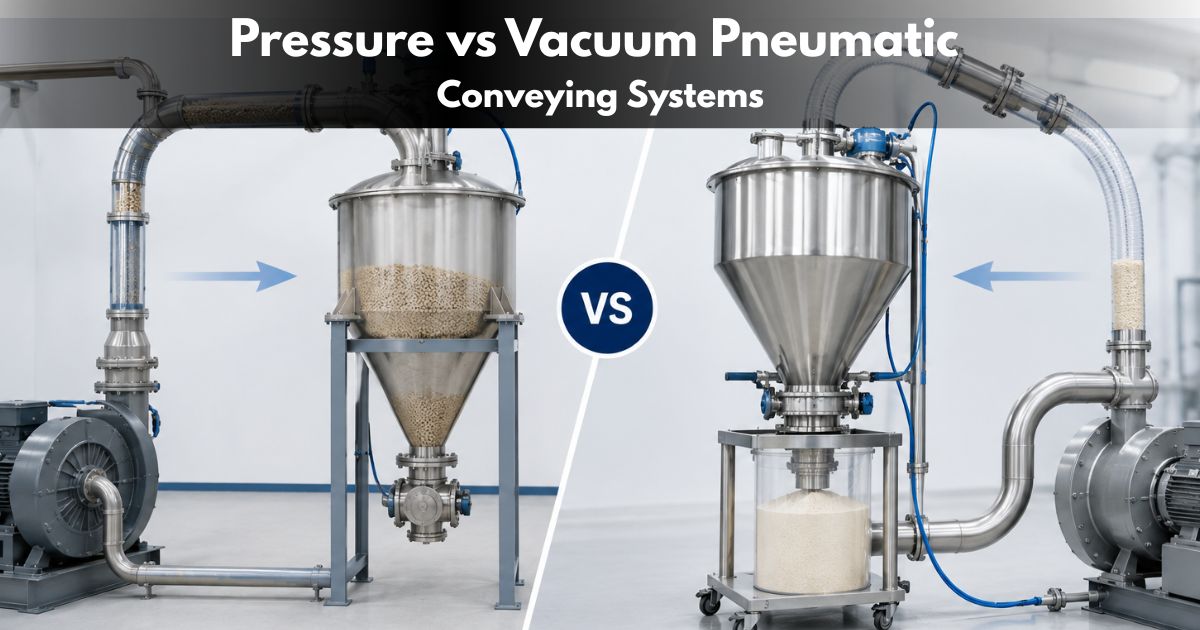
Pressure vs Vacuum Pneumatic Conveying Systems: Which One Should You Choose?
14 Aug 2026
At Orchid Material Handling Solutions, we design customized Pneumatic Conveying Systems for efficient, enclosed, and controlled transfer of powders, granules, and bulk solids. One of the first decisions we help manufacturers make is whether a Pressure Conveying System or a Vacuum Conveying System is more suitable for their application.
Both systems use air to move materials through pipelines, but they operate differently and offer distinct advantages. The right choice depends on factors such as material characteristics, conveying distance, capacity, number of pickup points, product sensitivity, and the overall plant layout.
If you’re planning a new conveying system or upgrading an existing one, understanding the difference between pressure and vacuum conveying can make the selection process much easier. You can also connect with our expert team to choose the right system for your application.
Pressure vs Vacuum Conveying: What Is the Difference?
The primary difference is where the conveying air is generated and how the material is moved through the pipeline.
A Pressure Pneumatic Conveying System uses positive air pressure to push material from the feeding point toward the destination.
A Vacuum Pneumatic Conveying System creates negative pressure to draw material from the pickup point toward the receiving equipment.
Both approaches can provide enclosed and dust-controlled material transfer, but their suitability changes depending on the application.
| Factor | Pressure Conveying | Vacuum Conveying |
| Operating Principle | Pushes material using positive pressure | Pulls material using negative pressure |
| Material Pickup | Generally from one controlled feeding point | Can collect from multiple pickup points |
| Destination | Multiple destinations possible with suitable design | Generally directed toward a central receiver |
| Suitable Applications | Long-distance and higher-capacity transfer | Hygienic, dust-sensitive and multi-pickup applications |
| Air Leakage Risk | Positive pressure can push material/dust outward through leaks | Air tends to enter through leaks, reducing contamination risk |
| Product Handling | Depends on system configuration | Can be suitable for sensitive materials |
| Typical Industries | Chemicals, minerals, plastics, cement | Food, pharma, nutraceuticals, chemicals |
The comparison is a starting point. The actual system should always be selected according to the material and process requirements.
How Does a Pressure Pneumatic Conveying System Work?
In a pressure conveying system, compressed air generated by a blower or compressor pushes the material through the conveying pipeline.
A typical process involves:
Material Feeding → Air Introduction → Pneumatic Conveying → Separation/Collection → Discharge
Pressure systems can be configured for different capacities and conveying distances and are often considered when material needs to be transferred from a defined source to one or more destinations.
When Should You Consider Pressure Conveying?
We generally recommend evaluating pressure conveying when your application requires:
- Longer conveying distances
- Higher material throughput
- Transfer from one source to multiple destinations
- Continuous material movement
- Efficient transfer of free-flowing bulk solids
Depending on the material, pressure conveying can be designed using dilute-phase or dense-phase configurations.
How Does a Vacuum Pneumatic Conveying System Work?
A vacuum conveying system uses a vacuum pump or blower to create negative pressure within the pipeline. This draws material from the pickup point toward a receiving vessel or separator.
A typical process involves:
Material Pickup → Vacuum Generation → Pipeline Conveying → Filtration/Separation → Material Discharge
Because the system operates under negative pressure, vacuum conveying can be particularly useful where dust containment and hygienic material transfer are important.
When Should You Consider Vacuum Conveying?
We generally recommend evaluating vacuum conveying when your application involves:
- Multiple material pickup points
- Hygienic processing requirements
- Fine powders
- Dust-sensitive environments
- Product contamination concerns
- Relatively shorter conveying routes
Vacuum conveying is widely considered in food, pharmaceutical, nutraceutical, and specialty chemical applications.
Pressure vs Vacuum: Which System Is Better for Powder Handling?
Neither system is universally better.
The right choice depends on how the powder behaves and what your process requires.
For example, if you’re transferring a powder from a storage silo to a processing or packaging line over a longer distance, a Pressure Conveying System may be worth considering.
If you’re collecting powder from multiple process points where contamination control is important, a Vacuum Conveying System may offer a more practical configuration.
Material characteristics such as bulk density, particle size, moisture, flowability, abrasiveness, and sensitivity should always be evaluated before making the final selection.
Which System Is Better for Food and Pharmaceutical Applications?
For food, pharmaceutical, and nutraceutical manufacturing, hygiene and contamination control are often major considerations.
Vacuum conveying can be advantageous because the negative pressure environment helps contain material within the conveying system. It can also support flexible pickup arrangements in applications where materials need to be collected from multiple points.
However, pressure conveying can also be appropriate for food and pharmaceutical applications when the system is correctly designed around the material, hygiene requirements, and process conditions.
At Orchid, we recommend the conveying principle based on the complete application, rather than assuming that vacuum is automatically the right choice for every hygienic process.
Which System Is Better for Long-Distance Conveying?
For longer conveying distances, pressure conveying is often considered because positive pressure can provide the driving force required to move materials efficiently through extended pipelines.
However, conveying distance alone should not determine the system.
The engineering assessment should also consider:
- Material properties
- Required throughput
- Pipeline diameter
- Number of bends
- Elevation changes
- Pressure drop
- Conveying phase
For demanding applications, a properly engineered system can be configured to balance conveying performance, energy consumption, and product integrity.
What Factors Should You Consider Before Choosing?
Material Characteristics
Understand bulk density, particle size, moisture, abrasiveness, flowability, and product sensitivity.
Conveying Distance
Longer routes may require a different conveying configuration from short material transfers.
Number of Pickup and Discharge Points
Vacuum can be particularly useful when material needs to be collected from several points, while pressure systems can be configured for multiple destinations.
Required Capacity
Your hourly throughput and production schedule will influence blower, pipeline, and feeding requirements.
Hygiene & Contamination Control
Food, pharmaceutical, and nutraceutical applications may require specific materials, filtration, sealing, and cleaning provisions.
Plant Layout
Available space, vertical lifts, pipeline routing, and integration with existing equipment should be considered before finalizing the system.
Common Mistakes When Selecting Pressure or Vacuum Conveying
A pneumatic conveying system should not be selected simply because one technology is cheaper or more commonly used in a particular industry.
Common mistakes include:
- Choosing a system without testing the material
- Selecting equipment only on initial cost
- Ignoring conveying distance
- Underestimating future production requirements
- Not considering product degradation
- Overlooking filtration and dust control
- Designing the conveyor without considering upstream and downstream equipment
We recommend evaluating the complete material handling process before deciding between pressure and vacuum conveying.
How Can Pressure or Vacuum Conveying Integrate With Other Equipment?
A pneumatic conveying system usually forms part of a larger production process.
Depending on the application, it may integrate with:
- Bulk Storage Systems
- Powder Handling Accessories
- Industrial Mixers
- Weighing & Batching Systems
- Bag Filling Systems
- Dust Air Filtration Systems
- Industrial Control Panels
Integrating these systems allows manufacturers to create a more automated material handling process with controlled transfer from storage through processing and packaging.
Why Choose Orchid Material Handling Solutions?
At Orchid Material Handling Solutions, we don’t recommend pressure or vacuum conveying based on a standard configuration. Our engineering team evaluates the material, production capacity, conveying distance, plant layout, hygiene requirements, and process integration before recommending a suitable pneumatic conveying solution.
Our expertise covers Pressure Conveying, Vacuum Conveying, Dilute Phase Conveying, and customized powder transfer systems, allowing us to develop solutions for food processing, pharmaceuticals, nutraceuticals, chemicals, plastics, minerals, fertilizers, and other bulk material handling applications.
We can also integrate pneumatic conveying with storage, mixing, weighing, batching, dust filtration, filling, and automation systems to create a complete material handling solution.
If you’re unsure whether pressure or vacuum conveying is right for your application, we recommend discussing the material and process requirements with an experienced engineering team before finalizing the equipment.
Frequently Asked Questions
Pressure conveying pushes material through a pipeline using positive air pressure, while vacuum conveying draws material toward the receiving point using negative pressure.
Not necessarily. Vacuum conveying can be advantageous for hygienic and multi-pickup applications, while pressure conveying may be more suitable for longer distances and higher-capacity transfer. The right option depends on the application.
Both can be used in food processing. Vacuum conveying may be preferred where contamination control and multiple pickup points are important, while pressure conveying can be suitable for specific high-capacity or longer-distance applications.
Pressure conveying is often considered for longer-distance applications, but the final selection depends on material characteristics, capacity, pipeline design, and conveying phase.
Yes. Pneumatic conveying systems can be customized according to material properties, throughput, conveying distance, plant layout, and integration requirements.
Orchid Material Handling Solutions evaluates your material and process requirements before recommending a suitable Pressure or Vacuum Pneumatic Conveying System. Our team can also integrate conveying with storage, mixing, batching, dust filtration, filling, and automation solutions for a complete material handling process.