- sales@orchidmhs.com
- +91 9322487698
- +91 7028807698
- ISO 9001:2015


Automated Conveyor Systems in Material Handling: Belt, Roller & Turntable Conveyors Explained
26 Jan 2026
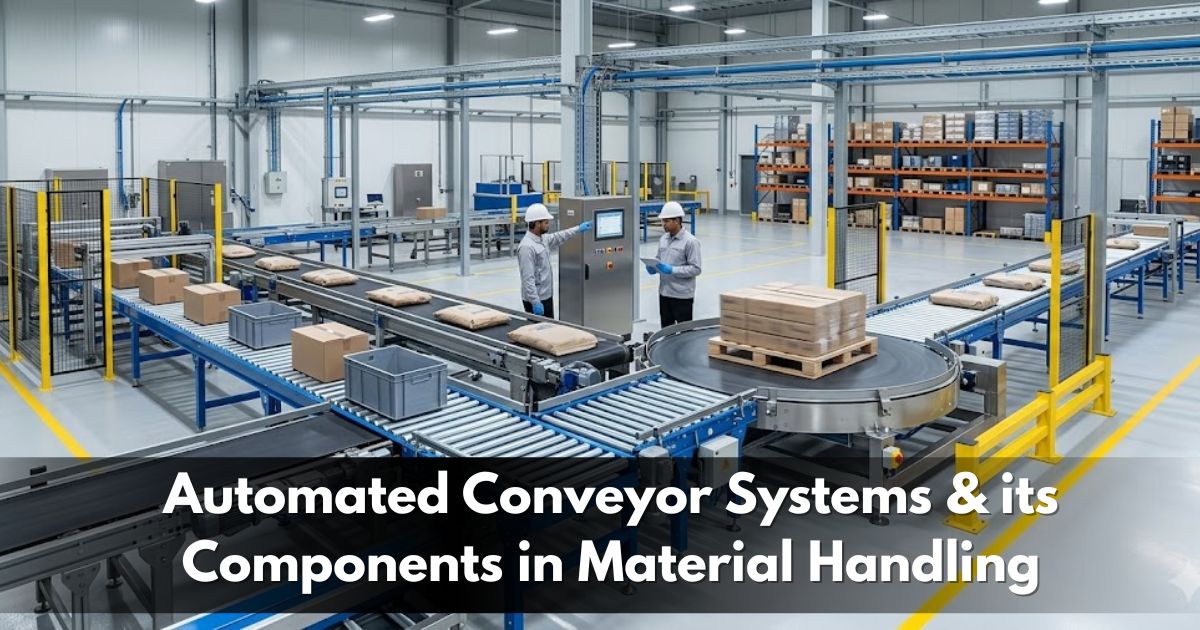
In modern industrial operations, efficiency, consistency, and safety are driving forces behind how material handling systems are designed and implemented. Among the many equipment types that move materials across a plant floor, automated conveyor systems play a central role. These systems not only streamline workflows, they also reduce labor costs, improve safety, and increase throughput for a wide range of industries from pharmaceuticals and food to chemicals and packaging.
At Orchid Material Handling Solutions, conveyors are part of a broader suite of engineered bulk handling systems, designed to ensure dust-free, hygienic, and high-accuracy operations tailored to specific industry requirements.
In this guide we will explore what automated conveyor systems are, break down the components and functions of three essential conveyor types – belt conveyors, roller conveyors, and turntable conveyors – and explain their industrial applications and benefits.
What Are Automated Conveyor Systems?
Automated conveyor systems are mechanical transport solutions that move materials from one point to another without manual effort. These systems can be integrated with control systems and sensors to operate with minimal human intervention. Unlike manual material transport methods that rely on labor, automated conveyors enhance consistency while reducing human error and fatigue.
The basic purpose of any conveyor system is to move materials efficiently and reliably within a plant, warehouse, or processing facility. Conveyor systems handle everything from raw materials through finished goods, helping companies maintain predictable production schedules and reduce operational bottlenecks.
Automated conveyors offer additional benefits such as:
- Increased throughput and reduced cycle times
- Better workplace safety by minimizing manual handling
- Lower operating costs over time
- Seamless integration with automation and warehouse management systems
Core Components of Automated Conveyor Systems
Regardless of type, most automated conveyor systems include these basic elements:
- Drive Mechanisms: These consist of motors, gearboxes, and variable speed drives that power the movement of belts or rollers.
- Control Systems: Programmable logic controllers (PLCs) and sensors regulate speed, direction, start/stop operations, and safety interlocks.
- Loading and Unloading Points: These are configured to feed materials onto or off the conveyor at appropriate steps in the process.
- Frames and Supports: Robust structural frameworks ensure stability and vibration-free operation.
- Guarding and Safety Devices: Sensors, guards, and emergency stops help protect operators and equipment.
The design and configuration of these components vary depending on the conveyor type and application.
Belt Conveyor Systems: Smooth and Versatile Material Movement
Overview
Belt conveyors are among the most commonly used automated conveyors. At Orchid Material Handling Solutions, belt conveyors are engineered for long-distance transport of bulk materials, powders, granules, and packaged goods.
A belt conveyor consists of a continuous loop of material, usually made of rubber or polymer, that moves over pulleys and idler rollers. The belt provides a flat surface where materials can be transported reliably and gently.
How Belt Conveyors Work
Material is placed on the conveyor belt at the loading point, and the belt then moves it along to a discharge point. The movement is powered by a drive pulley connected to an electric motor, while idler rollers support the belt and distribute material loads.
Industrial Applications
- Transporting powders and granules across processing lines
- Moving packaged products to packaging or palletizing stations
- Linking production steps in food, pharma, chemicals, and cement plants
Key Benefits
- Handles wide variety of bulk and unit loads
- Suitable for long distance material transfer
- Can be configured with incline, decline, and curves
- Supports automated feeding and sorting workflows
Belt conveyors are essential for processes where continuous and controlled movement of materials is needed without disrupting the production line.
Roller Conveyors: Efficient Unit Load Handling
Overview
Roller conveyors move materials over a series of cylindrical rollers. Orchid’s range includes gravity roller conveyors, powered roller conveyors, and chain-driven roller conveyors that are ideal for unit loads like cartons, bags, and crates.
How Roller Conveyors Work
Roller conveyors can be powered or unpowered:
- Gravity Roller Conveyors: Materials move by gravity or with a slight manual push.
- Powered Roller Conveyors: Motors or chains drive the rollers to move items automatically.
These systems are modular, easy to configure, and integrate with sensors and controls to automate movement.
Industrial Applications
- Packaging lines where cartons and bags move between stations
- Warehousing operations where items need to be sorted or routed
- Food, pharma, logistics, and automotive plants
Key Benefits
- Low maintenance and long service life
- Flexible layouts that adapt to plant changes
- Smooth and reliable handling of unit loads
Roller conveyors are often used in automated facilities to connect processes and reduce manual repositioning of products.
Turntable Conveyors: Directional Material Routing
Overview
Turntable conveyors are specialized conveyor sections that rotate to change the direction of material flow. They are particularly useful in automated systems where materials need to be diverted to different processing lines or storage areas.
Turntable conveyors act as pivot points on a conveyor network, helping materials change orientation or route without requiring complex layouts.
Industrial Applications
- Routing pallets or containers into different lanes
- Redirecting materials for secondary processing
- Creating sortation paths in packaging and dispatch areas
Key Benefits
- Flexible routing without complex mechanical changes
- Simplifies system layout when space is limited
- Helps automate sorting and distribution tasks
Turntables complement belt and roller conveyors by adding directional flexibility and improving system efficiency.
Industrial Applications of Automated Conveyor Systems
Automated conveyor systems are found across multiple industries, each benefiting from streamlined material movement:
Pharmaceutical and Food Processing: Conveyors move raw ingredients, semi-finished batches, and packaged goods in hygienic, dust-free workflows.
Chemical and Cement Plants: Robust conveyors handle powders and granules with precision and safety.
Warehousing and Packaging: Automated conveyors reduce reliance on manual labor, improve sorting accuracy, and optimize throughput.
By aligning conveying systems with automation controls, manufacturers can achieve real-time tracking, integration with PLC systems, and scalable production layouts.
Key Benefits of Automated Conveyor Systems
Automated conveyors deliver measurable operational improvements, including:
Improved Productivity: Reduced cycle times and continuous material flow increase output.
Enhanced Safety: Minimizing manual handling reduces injury risk.
Higher Consistency: Automated systems eliminate manual variation and deliver repeatable results.
Lower Operating Costs: Less reliance on manual labor and reduced downtime lower long-term costs.
Conclusion
Automated conveyor systems are foundational to efficient material handling in modern manufacturing environments. By combining belt, roller, and turntable conveyors into integrated, automated networks, companies can reduce manual labor, improve workflow continuity, and enhance safety and throughput.
Orchid Material Handling Solutions offers engineered conveyor systems designed for dust-free, high-accuracy performance across industries such as pharmaceuticals, food, chemicals, and packaging.
Whether you are transporting powders, bulk solids, or packaged goods, choosing the right combination of conveyor types positions your facility for higher efficiency, lower operational risk, and scalable production growth.