- sales@orchidmhs.com
- +91 9322487698
- +91 7028807698
- ISO 9001:2015


Role of Air Movers in Pneumatic Conveying: Blowers vs Compressors
01 Sep 2026
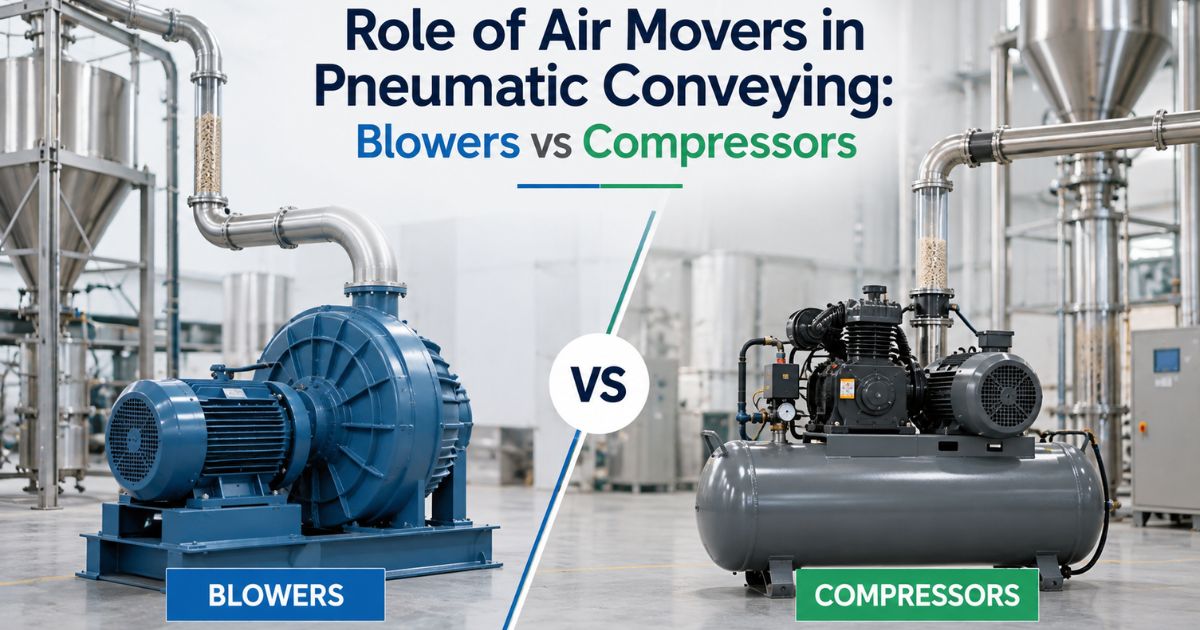
At Orchid Material Handling Solutions, we design customized Pneumatic Conveying Systems for the controlled movement of powders, granules, and bulk solids. One of the most important decisions in pneumatic conveying design is selecting the right air mover – typically a blower or compressor-to generate the airflow and pressure required to transport the material.
The air mover is effectively the driving force behind the conveying system. Selecting the wrong type or capacity can affect conveying efficiency, energy consumption, product quality, and equipment life. So, should you use a blower or compressor for pneumatic conveying? The answer depends on your material, conveying distance, pressure requirements, capacity, and system design.
What Is an Air Mover in a Pneumatic Conveying System?
An air mover is the equipment responsible for creating the airflow or pressure difference that transports material through a pneumatic conveying pipeline.
Depending on the system configuration, an air mover may be used to:
- Push material through a pipeline
- Create vacuum to pull material toward a receiver
- Maintain the required conveying velocity
- Overcome pipeline pressure losses
- Support continuous or batch material transfer
The two commonly considered options are positive displacement blowers and air compressors.
While both generate compressed air, they are designed to operate under different conditions and therefore aren’t interchangeable for every pneumatic conveying application.
Blower vs Compressor: What Is the Difference?
The simplest way to understand the difference is to look at air volume and pressure.
A blower generally delivers a high volume of air at relatively low pressure. This makes blowers suitable for many dilute-phase pneumatic conveying applications where maintaining sufficient airflow is more important than generating very high pressure.
A compressor generates higher-pressure air at comparatively lower flow rates. It can therefore be considered for applications where the conveying process requires higher pressure, such as certain dense-phase conveying configurations.
| Parameter | Blower | Compressor |
| Primary Characteristic | Higher air volume | Higher air pressure |
| Typical Pressure Range | Low to medium | Medium to high |
| Airflow | High | Comparatively lower |
| Common Application | Dilute-phase conveying | Dense-phase / high-pressure applications |
| Energy Requirement | Generally suitable for continuous airflow | Higher compression requirement |
| Best Suited For | Free-flowing powders & granules | Applications requiring higher conveying pressure |
These are general characteristics. The actual selection should be based on the complete conveying system and material properties.
When Should You Use a Blower for Pneumatic Conveying?
Blowers are commonly used when the conveying system requires a continuous and relatively high volume of air.
We typically recommend evaluating a blower when the application involves:
- Dilute-phase conveying
- Continuous material transfer
- Relatively high conveying airflow
- Powders and granules with suitable flow characteristics
- Moderate pressure requirements
For example, a food processing plant transferring a free-flowing powder over a defined distance may use a blower-based pneumatic conveying system to maintain the required conveying velocity.
Why Are Blowers Commonly Used?
A properly selected blower can provide:
- Consistent airflow
- Efficient continuous operation
- Reliable conveying performance
- Suitable air volume for dilute-phase systems
- Integration with automated conveying controls
However, blower selection should never be based only on airflow. Pipeline pressure drop, material loading, conveying distance, and system configuration all need to be considered.
When Should You Use a Compressor?
Compressors are considered when the pneumatic conveying application requires higher pressure than a conventional blower can efficiently provide.
They may be suitable for:
- Dense-phase conveying
- High-pressure material transfer
- Applications involving difficult-to-convey materials
- Specific batch conveying configurations
- Systems requiring compressed air for additional equipment
Dense-phase conveying moves material at lower velocity and higher pressure, often in plugs or slugs. The higher pressure generated by an appropriate compressor or pressure source helps move the material through the pipeline.
For sensitive or abrasive materials, this lower conveying velocity can also help reduce product degradation and pipeline wear when the system is correctly engineered.
Blower or Compressor: Which One Is More Energy Efficient?
There is no universal answer.
Energy efficiency depends on how well the air mover matches the conveying requirements.
Using a compressor where only high-volume, moderate-pressure airflow is required may result in unnecessary energy consumption. Similarly, using a blower for an application that requires significantly higher pressure may lead to poor conveying performance.
We recommend selecting the air mover based on:
- Required airflow
- Required pressure
- Material loading
- Conveying distance
- Pipeline diameter
- Number of bends
- Elevation changes
- Operating hours
The objective should be to achieve the required conveying performance without generating more airflow or pressure than the process actually needs.
How Does the Air Mover Affect Conveying Velocity?
Air velocity is one of the most important parameters in pneumatic conveying.
If the velocity is too low, material can settle inside the pipeline, potentially causing blockages.
If the velocity is too high, it can lead to:
- Increased energy consumption
- Product degradation
- Higher pipeline wear
- Excessive dust
- Increased operating costs
The air mover therefore needs to be selected and controlled to maintain the appropriate conveying conditions.
This is particularly important when handling fragile food ingredients, pharmaceutical powders, plastic pellets, or abrasive minerals, as each material can have different conveying requirements.
What Factors Should Be Considered Before Selecting an Air Mover?
At Orchid material handling we checked all the required parameters before selection.
Material Characteristics
Start with the material itself.
Consider:
- Bulk density
- Particle size
- Moisture content
- Flowability
- Abrasiveness
- Product sensitivity
A material’s characteristics influence the conveying phase, required velocity, pressure, and overall air requirements.
Conveying Distance
Longer conveying distances generally create greater pressure losses.
Pipeline length, bends, vertical lifts, and transfer points should therefore be evaluated before selecting the blower or compressor.
Required Throughput
The required material flow rate directly influences system sizing.
Consider your:
- kg/hour requirement
- Batch size
- Operating hours
- Peak production rate
- Future production expansion
Conveying Phase
The choice between Dense Phase and Dilute Phase Conveying has a major impact on air requirements.
Dilute phase generally requires higher air velocity and substantial airflow, while dense phase operates at lower velocity and higher pressure.
Vacuum or Pressure Conveying
If the system uses vacuum conveying, the air mover selection will be different from a positive-pressure conveying arrangement.
Vacuum systems require a suitable vacuum source capable of maintaining the required negative pressure throughout the conveying cycle.
What Happens If the Air Mover Is Incorrectly Sized?
An incorrectly selected air mover can affect the entire pneumatic conveying system.
Undersized Air Mover
An undersized blower or compressor may result in:
- Insufficient conveying velocity
- Material settling
- Pipeline blockages
- Reduced throughput
- Unstable conveying performance
Oversized Air Mover
An oversized air mover can create different problems:
- Higher energy consumption
- Excessive air velocity
- Product degradation
- Increased pipeline wear
- Higher operating costs
This is why we recommend system-level engineering rather than selecting the largest available blower or compressor.
How Air Movers Integrate With a Complete Pneumatic Conveying System
The blower or compressor is only one component of a complete conveying system.
A typical arrangement may include:
Material Source → Feeding Equipment → Air Injection → Conveying Pipeline → Receiver/Separator → Filtration → Material Discharge
Depending on the application, the system may also integrate with:
- Bulk Storage Systems
- Powder Handling Accessories
- Industrial Mixers
- Weighing & Batching Systems
- Bag Filling Systems
- Dust Air Filtration Systems
This integration is particularly important in automated manufacturing environments where material needs to move continuously between storage, processing, and packaging stages.
Common Mistakes When Selecting Blowers or Compressors
A few common mistakes can negatively affect pneumatic conveying performance:
- Selecting the air mover based only on material capacity
- Ignoring pipeline pressure losses
- Using excessive conveying velocity
- Not considering material characteristics
- Oversizing the blower or compressor
- Ignoring future production requirements
- Treating the air mover as a standalone component
A pneumatic conveying system should be designed as a complete process rather than sizing each component independently.
Why Choose Orchid Material Handling Solutions?
At Orchid Material Handling Solutions, we approach pneumatic conveying from an application and engineering perspective. Our team evaluates the material characteristics, required throughput, conveying distance, pipeline configuration, conveying phase, and plant layout before determining the appropriate air-moving arrangement.
Our Pneumatic Conveying Systems can be engineered around blower-based or compressor-based configurations, including dilute-phase and dense-phase applications. We also integrate pneumatic conveying with storage, feeding, batching, mixing, dust filtration, filling, and automation equipment to create complete material handling solutions.
If you’re unsure whether your application requires a blower, compressor, or vacuum source, we recommend evaluating the complete conveying requirement before selecting the equipment.
Frequently Asked Questions
A blower generates the high-volume airflow required to transport materials through a pneumatic conveying pipeline. It is commonly used for applications where continuous airflow at relatively low to moderate pressure is required.
Yes. Compressors can be used for pneumatic conveying applications requiring higher pressure, including certain dense-phase conveying configurations.
Neither is universally better. Blowers are generally suitable for high-airflow, lower-pressure applications, while compressors are considered where higher pressure is required. The right choice depends on the material, conveying phase, distance, throughput, and system design.
Yes. Blowers are commonly used in dilute-phase pneumatic conveying systems where relatively high airflow is required to maintain material suspension.
Dense-phase conveying operates at lower material velocities and higher pressure. A suitable compressor or pressure source can provide the pressure required to move concentrated material through the pipeline.
Orchid evaluates material characteristics, required capacity, conveying distance, pipeline configuration, conveying phase, and process requirements before recommending an appropriate blower, compressor, or vacuum arrangement for the pneumatic conveying system.