- sales@orchidmhs.com
- +91 9322487698
- +91 7028807698
- ISO 9001:2015


Top 10 Problems in Powder Handling and How to Fix Them in Your Production Line
05 Jan 2026
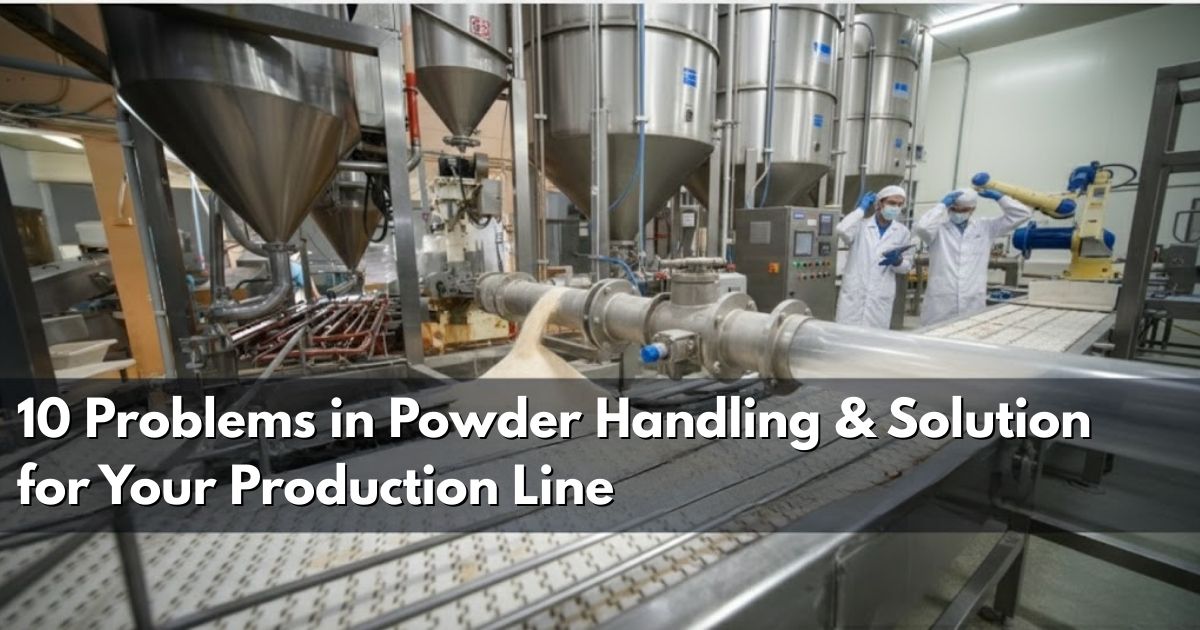
Powder handling looks simple on paper, but anyone working on a production floor knows how challenging it can be in real life. Powders behave very differently from solid materials. They flow unpredictably, react to moisture, generate dust, and often create operational issues that slow down production or compromise safety.
In industries like food processing, pharmaceuticals, chemicals, and minerals, inefficient powder handling can lead to material loss, contamination, downtime, and increased operational costs. Understanding common problems and fixing them early makes a significant difference in long term performance.
Below are the ten most common powder handling problems faced in manufacturing and practical ways to solve them.
Poor Flowability and Material Blockages
One of the most frequent powder handling problems is inconsistent flow. Powders often bridge, arch, or rat-hole inside hoppers and silos, preventing smooth discharge.
This usually happens due to particle size variation, moisture absorption, or poor hopper design. When powder does not flow freely, production becomes uneven and operators are forced to intervene manually.
How to fix it:
- Start with proper hopper and chute design that matches the powder characteristics. Flow aids such as vibrators, air pads, or agitation systems help break bridges and maintain steady discharge. Testing powder behavior before finalizing equipment design is always recommended.
Dust Generation and Airborne Contamination
Powder handling almost always creates dust, especially during transfer, mixing, or packaging. Excessive dust not only leads to material loss but also creates health risks and housekeeping challenges.
Airborne dust can contaminate nearby processes and reduce overall product quality.
How to fix it:
- Use enclosed conveying systems wherever possible. Dust collection units, proper sealing at transfer points, and controlled material discharge significantly reduce dust release. Regular maintenance of filters and extraction systems is equally important.
Segregation of Powder Materials
Powder segregation occurs when particles separate based on size, density, or shape during handling or transport. This leads to inconsistent product composition, which is a serious issue in industries requiring precise formulations.
Segregation often happens during free fall, vibration, or long-distance conveying.
How to fix it:
- Reduce drop heights and avoid unnecessary vibration. Use mass flow hoppers instead of funnel flow designs. Where possible, implement gentle conveying methods such as pneumatic dense phase systems to maintain material uniformity.
Moisture Absorption and Caking
Many powders are hygroscopic, meaning they absorb moisture from the air. This causes clumping, caking, and loss of flowability, especially in humid environments.
Moisture-related issues also increase cleaning frequency and equipment wear.
How to fix it:
- Control humidity levels within storage and processing areas. Use sealed containers, dehumidifiers, and moisture resistant liners. For sensitive powders, nitrogen purging or climate-controlled storage can be highly effective.
Inconsistent Feeding and Dosing Accuracy
Accurate feeding is critical in production lines where precise quantities are required. Powders often cause feeder surging, inconsistent discharge rates, or inaccurate dosing.
This problem directly affects product quality and batch consistency.
How to fix it:
- Use feeders designed specifically for powders, such as loss-in-weight or twin screw feeders. Regular calibration and proper feeder selection based on powder properties help maintain accuracy. Consistent upstream flow also improves feeder performance.
Equipment Wear and Abrasion
Certain powders are abrasive in nature and gradually wear down equipment surfaces. Over time, this leads to leaks, contamination, and frequent breakdowns.
Ignoring wear issues increases maintenance costs and unexpected downtime.
How to fix it:
- Select wear resistant materials such as hardened steel or special coatings for high contact areas. Design systems with easy access for inspection and part replacement. Preventive maintenance schedules help catch wear issues early.
Powder Build-Up and Material Residue
Powder build-up inside conveyors, hoppers, and pipelines reduces system efficiency and creates hygiene concerns. Residue accumulation is especially problematic in food and pharmaceutical manufacturing.
It also increases cleaning time during product changeovers.
How to fix it:
- Design equipment with smooth internal surfaces and minimal dead zones. Use clean-in-place or easy access cleaning features. Proper system alignment and airflow also reduce material sticking.
Electrostatic Charging and Safety Risks
Powder handling can generate static electricity due to friction and particle movement. This creates risks of sparks, fires, or explosions, particularly in combustible powders.
Static issues are often underestimated until an incident occurs.
How to fix it:
- Ensure proper grounding and bonding of all equipment. Use anti-static materials and conductive components where required. In high-risk environments, explosion protection systems and safety audits are essential.
Poor System Integration Across the Production Line
Powder handling systems often operate independently from other production equipment. Lack of integration leads to mismatched speeds, bottlenecks, and inefficient workflows.
This disconnect makes scaling production difficult.
How to fix it:
- Design powder handling systems as part of the overall production layout. Integration with control systems and real-time monitoring improves coordination. Experienced solution providers like Orchid Material Handling focus on designing systems that align seamlessly with existing production lines.
High Product Loss and Waste
Powder loss during handling adds up quickly, especially in high volume operations. Spillage, dust loss, and leftover residue reduce yield and increase raw material costs.
Many manufacturers underestimate how much material is wasted daily.
How to fix it:
- Improve containment, reduce transfer points, and optimize equipment alignment. Accurate weighing systems and closed-loop handling reduce waste significantly. Regular audits help identify loss points across the line.
Final Thoughts
Powder handling challenges are common, but they are not unavoidable. Most problems stem from poor system design, lack of understanding of powder behavior, or outdated equipment. Addressing these issues requires a combination of proper engineering, process optimization, and ongoing monitoring.
When powder handling systems are designed thoughtfully, production becomes smoother, safer, and more consistent. The right solutions not only reduce downtime and waste but also improve product quality and operational confidence.