- sales@orchidmhs.com
- +91 9322487698
- +91 7028807698
- ISO 9001:2015


Common Problems with Dilute Phase Conveying Systems
06 Jun 2026
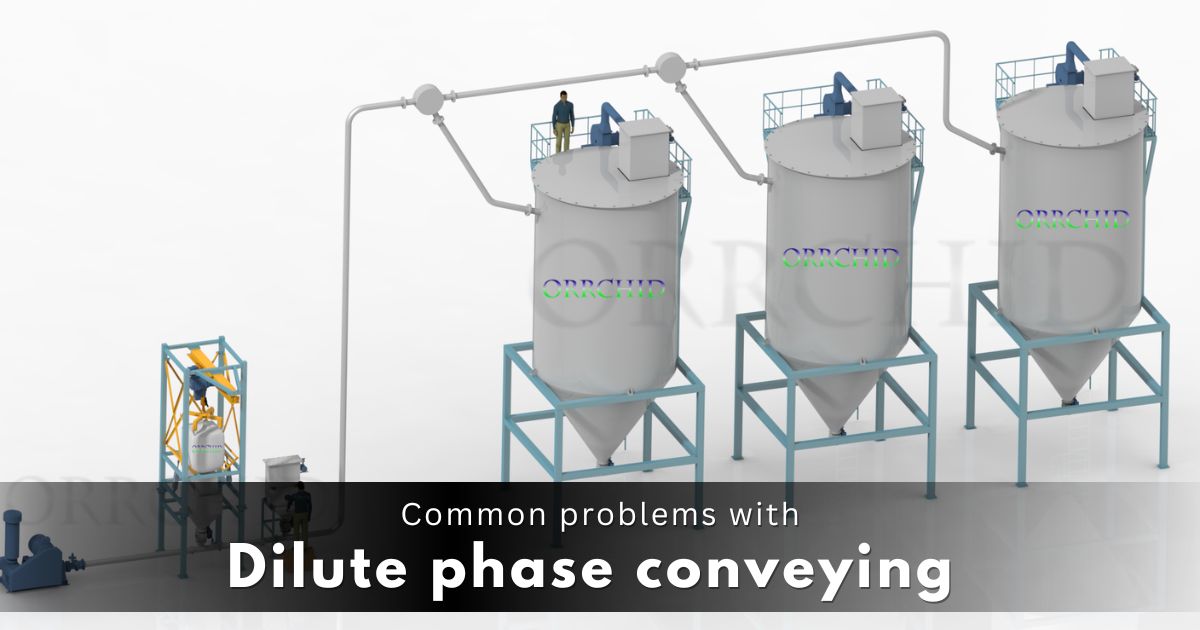
We Orchid Material Handling Solutions have designed and commissioned dilute phase systems across pharma, food, chemical, and plastics industries for over 18 years. The problems that appear are almost mostly the same – and so are the fixes.
Dilute phase conveying is one of the most widely used methods for transporting powders and granules across industries. It is efficient, flexible, and relatively straightforward to install.
But when something goes wrong, it affects the entire production line – throughput drops, product quality suffers, and maintenance costs rise quickly.
Initially we also faced problems during conveying. Over the time we worked on that & resolved the issues. Now we are sharing our experience & solutions on dilute phase conveying systems with our business partner.
This guide covers the most common issues, their root causes, and what actually resolves them.
Common Problems in Dilute Phase Conveying Systems
1. Pipeline Blockages
Based on the Orchid experience over the times. We received a lot of feedback from customers who are facing this issue due to wrong selection of equipment sizing. We visited the sites & guided them. How to resolve this type of problem. At some places we have changed some components. For smooth operation. Now here we are sharing our experiences & solutions with you.
This is the most frequently reported problem. The line operates normally and then suddenly chokes – material builds up and the pipeline plugs.
Causes:
- Air velocity dropping below saltation velocity (minimum speed to keep particles in suspension)
- Moisture in conveying air causing particles to clump
- Incorrect pipe sizing at the design stage
- Sharp bends creating dead zones and material buildup.
Fixes:
- Audit conveying velocity across the full pipeline length, especially at end runs
- Install inline air dryers or moisture separators at the blower inlet
- Replace sharp 90° elbows with long-radius bends at critical points
- Review pipeline layout for horizontal runs longer than design specification
2. Material Degradation and Particle Breakage
If conveyed material shows increased fines, broken particles, or off-spec particle size, the system is causing attrition during transport.
Causes:
- Excessive conveying velocity creating high-impact collisions at bends
- Sharp elbows concentrating material impact
- Wrong conveying mode selected for fragile or sensitive materials.
Fixes:
- Reduce conveying velocity to the lowest level that maintains suspension
- Install ceramic-lined or blind-tee elbows at high-impact zones
- Evaluate whether dense phase conveying is more appropriate for fragile materials
3. Pipeline Wear and Erosion
Abrasive materials wear through pipelines from the inside – especially at bends. The first sign is often a fine dust cloud near elbows. Left unchecked, it becomes a pipeline failure.
Causes:
- High-velocity abrasive particles repeatedly striking pipe walls at directional changes
- Standard mild steel pipelines used where harder materials are required
- Operating velocities higher than system design
Fixes:
- Fit ceramic-lined or hardened steel elbows in all high-wear zones
- Conduct periodic ultrasonic wall thickness checks on bends
- Replace pipe sections when wall thickness reduces by 30% or more – do not delay
4. Filter Receiver Inefficiency
The filter receiver separates conveyed material from the carrying air at the destination. When it underperforms, product carryover into exhaust, dust emissions, and pressure imbalance follow.
Causes:
- Clogged filter bags from infrequent pulse-jet cleaning cycles
- Filter area undersized for actual operating airflow
- Damaged or torn filter bags not replaced on schedule
Fixes:
- Set pulse-jet cleaning cycles based on differential pressure readings, not fixed timers
- Inspect filter bags every quarter – a single torn bag bypasses the entire filtration stage
- Verify filter receiver sizing against actual airflow at commissioning
5. Air Leakage
Even small air leaks reduce effective conveying pressure, increase energy consumption, and create dust hazards around the pipeline.
Causes:
- Poorly sealed flanged joints
- Worn rotary valve tip seals – the most commonly overlooked component
- Stress cracks from thermal cycling in outdoor installations
Fixes:
- Use soap-water or ultrasonic leak detection during commissioning and annual maintenance
- Inspect and replace rotary valve tip seals every 6 months under normal conditions
- Specify gasket materials rated for system operating pressure and temperature
6. Inconsistent Feed Rate
The system conveys, but throughput fluctuates. Downstream processes cannot batch correctly, and operators continuously adjust settings to compensate.
Causes:
- Rotary valve speed not matched to blower capacity
- Material bridging or rat-holing in the feed hopper
- Bulk density variation across batches affecting material-to-air ratio
Fixes:
- Install a variable frequency drive (VFD) on the rotary valve for real-time throughput control
- Add a hopper agitator or bin activator for cohesive or moisture-sensitive materials
- Recalibrate the system when switching between material grades or batches
7. Blower Overheating and Tripping
The blower is the core of any dilute phase system. When it overheats or trips, all conveying stops.
Causes:
- Choked inlet or outlet filters restricting airflow
- Operating beyond rated pressure differential
- Missed lubrication and belt tension checks
Fixes:
- Clean inlet filters weekly in dusty environments
- Install a differential pressure gauge across the blower to detect developing faults early
- Follow manufacturer preventive maintenance schedules without exception
Related Resource: Understanding the problem is only the first step. Read our Detailed guide on Troubleshooting Tips for Dilute Phase Conveying Systems for practical solutions.
Problem Summary Table
| Problem | Primary Cause | Fix |
| Pipeline blockage | Velocity below saltation point / moisture | Velocity audit, air dryer, long-radius bends |
| Material degradation | Excess velocity, sharp bends | Reduce velocity, ceramic elbows |
| Pipeline erosion | Abrasive material at high velocity | Ceramic lining, wall thickness monitoring |
| Filter inefficiency | Clogged or damaged filter bags | Pressure-based pulse-jet tuning, quarterly inspection |
| Air leakage | Worn seals, poor joint sealing | Leak detection, rotary valve seal replacement |
| Inconsistent feed rate | Bridging, mismatched valve speed | VFD control, hopper agitator |
| Blower failure | Choked filters, missed PM | Filter cleaning, differential pressure monitoring |
How to Extend the Life of Your Dilute Phase System
Proactive management is the difference between a system that lasts 15 years and one that requires constant unplanned maintenance.
What actually makes a difference:
- Monitor differential pressure readings consistently – they reflect the health of your pipeline and filter in real time
- Run velocity audits annually or whenever material or throughput changes
- Maintain a maintenance log of wear measurements, seal replacements, and filter bag changes – patterns predict failures before they occur
- Train operators to recognize early warning signs: unusual blower noise, pressure fluctuations, visible dust near joints
- Review system parameters after any material grade change – bulk density and particle size directly affect conveying conditions
Problems That Start at the Design Stage
A significant share of recurring operational problems in dilute phase systems are rooted in design errors – undersized pipelines, incorrect air-to-material ratios, or poorly located receivers.
Maintenance alone cannot permanently fix a design problem.
If your system faces recurring issues despite regular maintenance, a design review is the right step – not another round of part replacements. For new systems, investing in proper engineering upfront consistently costs less than retrofitting later.
Orchid Material Handling Solution provides engineering consultancy and system audits alongside conveying equipment, because identifying the root cause is always more valuable than replacing components.
You can connect with us for your queries. Mail id – sales@orchidmhs.com | Website – https://www.orchidmaterialhandling.com/contact-us/ | contact no. +91 9322487698 | Social– facebook, linkedin
FAQs
15–25 m/s for most powders – below this, particles drop out of suspension and block the pipeline.
Compare particle size before and after conveying – more fines or broken particles means the system is causing attrition.
No – it suits free-flowing, non-fragile materials only; fragile or abrasive materials need dense phase conveying.
Tip seals every 6 months, rotor clearances and bearings annually.
Pipeline erosion, clogged filters, air leaks, and blower wear progressively increase power draw without any gain in throughput.