- sales@orchidmhs.com
- +91 9322487698
- +91 7028807698
- ISO 9001:2015


How to Select the Right Conveyor for a Food Processing Plant?
06 Aug 2026
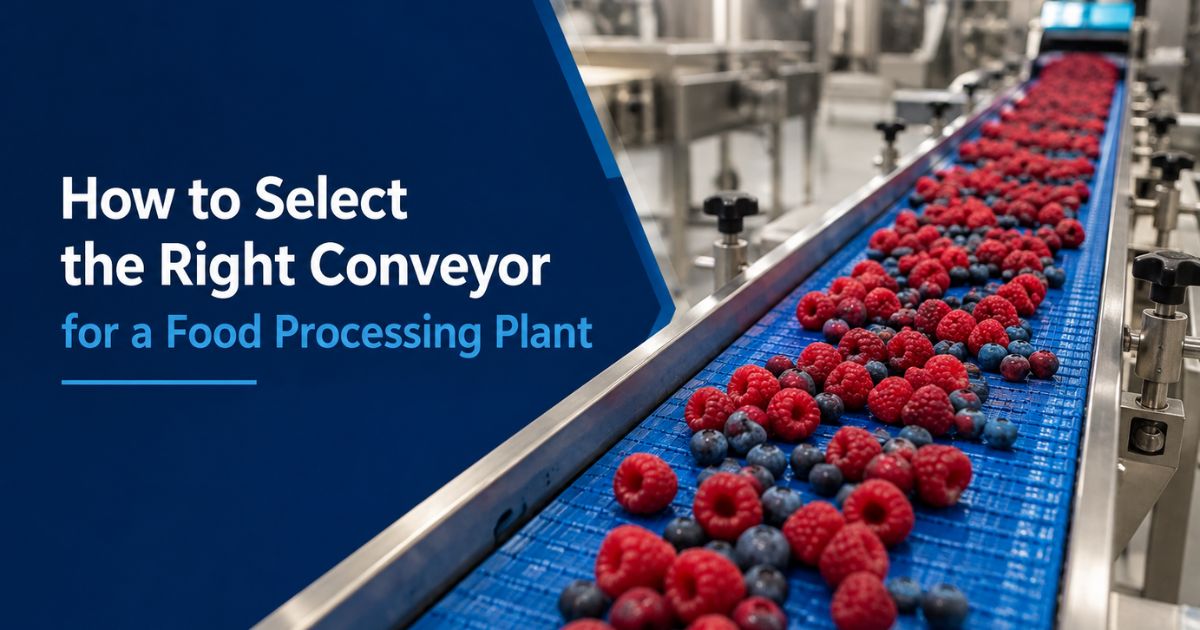
At Orchid Material Handling Solutions, we recommend selecting a conveyor based on the complete application rather than choosing equipment only by capacity or price. Our Mechanical Conveyor Systems are customized around the material, production process, plant layout, and hygiene requirements of each food processing facility.
Choosing a conveyor for a food processing plant is not simply about moving ingredients or finished products from one point to another. The right conveyor needs to handle the material efficiently while maintaining hygiene, product quality, food safety, and consistent production flow.
From flour, sugar, and spices to grains, powders, packaged food products, and other bulk ingredients, every material behaves differently during conveying. Factors such as moisture, particle size, flowability, temperature, product sensitivity, conveying distance, and required capacity can influence the type of conveyor you should select.
What Should You Consider Before Selecting a Conveyor for Food Processing?
A food processing conveyor should support three things at the same time: efficient material movement, hygienic operation, and consistent production performance.
Before finalizing a conveyor, we recommend evaluating the following factors.
1. Identify the Material You Need to Convey
The first question is simple: What exactly will the conveyor handle?
A food processing plant may deal with:
- Flour and starch
- Sugar and salt
- Grains and cereals
- Spices
- Pulses
- Milk powder
- Cocoa and food additives
- Packaged food products
The physical properties of the material can significantly influence conveyor selection.
For example, free-flowing powders may require a different conveying solution than fragile granules or finished packaged products. If you’re handling powder or bulk ingredients, we recommend evaluating bulk density, particle size, moisture content, flowability, and product sensitivity before selecting the equipment.
2. Consider the Hygiene Requirements
Hygiene is one of the most important considerations when selecting a conveyor for food processing.
The equipment should be designed to minimize contamination risks and allow easy cleaning and inspection.
Depending on the application, look for:
- Food-grade construction
- Stainless steel contact surfaces
- Easy-to-clean components
- Minimal material accumulation points
- Proper sealing
- Accessible inspection areas
For applications with strict hygiene requirements, SS304 or SS316L construction may be considered depending on the product and process environment.
At Orchid, we recommend selecting the construction material based on the product characteristics, cleaning process, and applicable industry requirements rather than using the same configuration for every food application.
3. Determine the Required Production Capacity
Your conveyor needs to comfortably handle the required production volume.
Consider:
- Material throughput per hour
- Batch size
- Continuous or batch processing
- Peak production requirements
- Future production expansion
For example, selecting equipment only for your current production capacity may create limitations when the plant expands.
We recommend allowing reasonable capacity flexibility where future production growth is expected. This can help avoid replacing or significantly modifying the conveyor system later.
4. Look at the Plant Layout and Conveying Distance
Food processing facilities often have complex layouts, multiple processing stages, and limited installation space.
Before selecting a conveyor, evaluate:
- Horizontal conveying distance
- Vertical elevation
- Available floor space
- Transfer points
- Number of bends or direction changes
- Existing processing equipment
The conveyor should fit naturally into the production workflow rather than forcing unnecessary changes to the plant layout.
A customized conveyor arrangement can help maintain smoother material flow between storage, processing, mixing, filling, and packaging stages.
5. Select the Right Conveyor Type
There is no single conveyor that works best for every food processing application.
The right choice depends on what you’re conveying and where it needs to go.
At Orchid Material Handling Solutions, we recommend conveyor systems only after a detailed evaluation of your material and process requirements. We don’t believe in a one-size-fits-all approach.
Screw Conveyors
Screw conveyors are commonly used for controlled movement of powders, granules, and other bulk food ingredients.
They can be considered for applications involving:
- Flour
- Sugar
- Spices
- Starch
- Other free-flowing bulk materials
They are particularly useful where controlled and enclosed material transfer is required.
Belt conveyors are widely used for food products, packaged goods, boxes, bags, and other materials that can be transported continuously on a belt surface.
They can be configured according to the product, conveying distance, and production requirements.
If material needs to move vertically between different processing levels, bucket elevators can be an effective solution.
They are commonly considered for handling grains, cereals, powders, and other bulk materials where vertical elevation is required.
For fine powders and bulk solids where enclosed, dust-controlled transfer is important, pneumatic conveying can be considered.
Depending on the material and process requirements, vacuum or pressure conveying may be used.
At Orchid Material Handling Solutions, we recommend the conveyor type only after evaluating the material and process requirements rather than treating one technology as a universal solution.
How Do You Choose Between Mechanical and Pneumatic Conveying?
This is an important decision for many food processing plants.
Mechanical conveyors are generally suitable when the material needs to be moved using physical conveying components such as screws, belts, chains, or buckets.
Pneumatic conveying uses controlled airflow to transport powders and bulk solids through enclosed pipelines.
As a general rule, we recommend considering mechanical conveying when the application requires controlled movement over a defined route, while pneumatic conveying can be advantageous when enclosed transfer, flexible routing, or dust-controlled powder handling is a priority.
The final decision should always be based on material characteristics, conveying distance, capacity, hygiene requirements, and the overall production process.
Orchid expert team always ensure the best suitable system based on product & requirement of end user to make the system long term working, safety & smooth process flow.
Don’t Overlook Product Handling and Material Sensitivity
Food products can be sensitive to mechanical impact, heat, pressure, and excessive conveying speed.
If you’re handling fragile materials, consider whether the selected conveyor could cause:
- Product breakage
- Particle degradation
- Segregation
- Excessive friction
- Material buildup
We recommend selecting the conveying method and operating conditions according to the product’s sensitivity. A faster conveyor is not necessarily a better conveyor if it compromises product quality.
Consider Integration With the Complete Production Line
A conveyor rarely works as a standalone piece of equipment in a modern food processing plant.
It may need to integrate with:
- Bulk Storage Systems
- Bag Dischargers
- Weighing & Batching Systems
- Industrial Mixers
- Bag Filling Systems
- Dust Air Filtration Systems
- Industrial Control Panels
- Packaging Equipment
An integrated approach helps maintain consistent material flow from raw material receiving through processing and final packaging.
At Orchid, we focus on designing material handling solutions that work as part of the complete production process rather than treating each machine as an isolated system.
Common Mistakes to Avoid When Selecting a Food Processing Conveyor
Some of the most common mistakes we see include:
- Selecting equipment based only on purchase price
- Ignoring hygiene and cleaning requirements
- Underestimating future production capacity
- Choosing the conveyor before evaluating material characteristics
- Overlooking available plant space
- Not considering integration with upstream and downstream equipment
- Failing to plan for maintenance and accessibility
A slightly higher initial investment in the right system can often deliver better reliability and lower operational costs over its lifecycle.
Why Choose Orchid Material Handling Solutions?
At Orchid Material Handling Solutions, we approach conveyor selection from an application-first perspective.
Instead of simply asking, “Which conveyor do you need?”, our team looks at what material you are handling, how much you need to move, how far it needs to travel, what hygiene standards apply, and how the conveyor needs to integrate with the rest of your production line.
Based on these requirements, we design customized solutions including Mechanical Conveyors, Pneumatic Conveying Systems, Bulk Storage Systems, Industrial Mixers, Weighing & Batching Systems, Bag Filling Systems, Powder Handling Accessories, and Dust Air Filtration Systems.
Our recommendation is simple: choose the conveyor around your process, not the other way around.
If you’re planning a new food processing line or upgrading an existing material handling system, connect with the Orchid team to discuss your application and identify the most suitable conveying solution.
Frequently Asked Questions
There is no single best conveyor for every food processing application. Screw conveyors, belt conveyors, bucket elevators, and pneumatic conveying systems can each be suitable depending on the material, capacity, conveying distance, hygiene requirements, and plant layout.
Stainless steel, particularly SS304 and SS316L, is commonly considered for food processing applications where hygiene, corrosion resistance, and cleanability are important. The appropriate grade depends on the specific process and product.
Yes. Pneumatic conveying can be suitable for powders and bulk solids in food processing where enclosed and dust-controlled material transfer is required. The system should be designed according to the material characteristics and process requirements.
Start with your required hourly throughput, batch size, operating hours, and future production requirements. We recommend selecting a system with sufficient capacity for current production while considering expected future expansion.
Yes. In fact, using different conveying technologies at different stages of a production process can often be the most practical approach. For example, a plant may use screw conveyors for powder transfer, bucket elevators for vertical movement, and belt conveyors for packaged products.
Orchid evaluates the material characteristics, production capacity, conveying distance, hygiene requirements, plant layout, and integration requirements before recommending a solution. This helps ensure that the selected conveyor supports the complete production process rather than solving only one part of it.