- sales@orchidmhs.com
- +91 9322487698
- +91 7028807698
- ISO 9001:2015


Common Material Handling Challenges in Food Processing Plants and How Automation Solves Them
08 Jan 2026
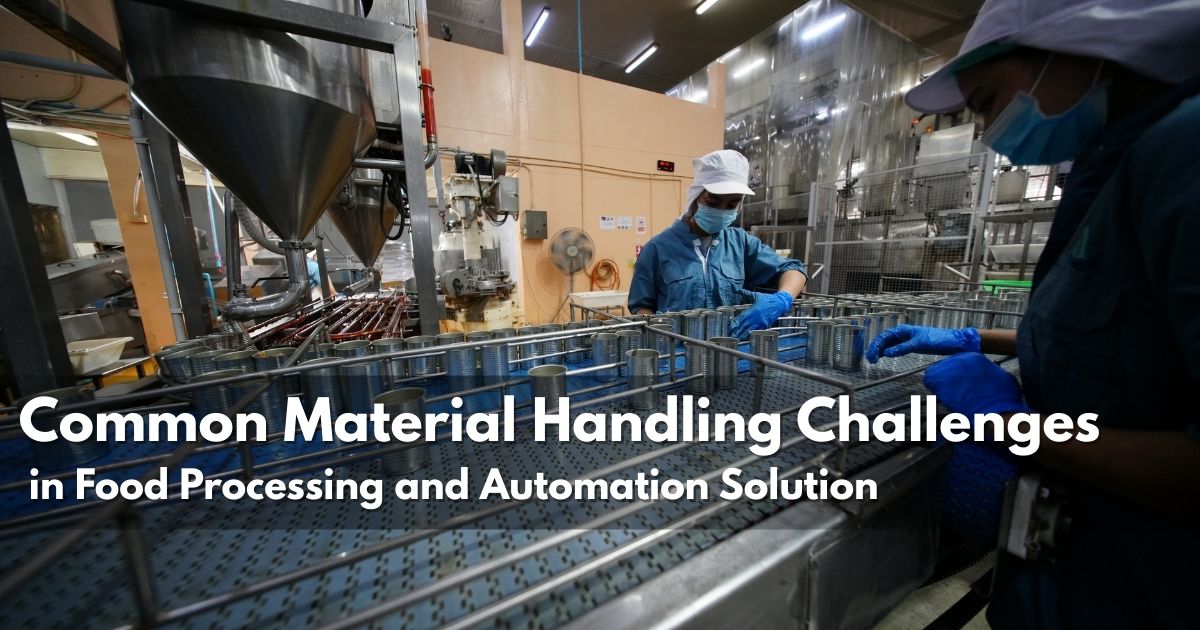
Food processing plants operate under constant pressure. Products must move fast, hygiene standards must remain uncompromised, and production lines cannot afford frequent stoppages. In this environment, material handling becomes one of the most critical yet challenging aspects of operations.
Unlike general manufacturing, food processing involves raw ingredients, semi-processed items, and finished products that are sensitive to contamination, moisture, temperature, and handling methods. Manual processes that once worked well often fail to keep up with modern production demands. This is where automation plays a transformative role.
Let us explore the most common material handling challenges faced by food processing plants and how automation helps overcome them effectively.
Contamination Risks During Material Movement
One of the biggest challenges in food processing is preventing contamination. Raw ingredients are often exposed during transport, transfer, and storage. Manual handling increases the chances of foreign particles, human contact, and cross-contamination between batches.
Even minor lapses can lead to product recalls, regulatory penalties, and damage to brand reputation.
How automation helps:
- Automated conveying systems reduce human contact with food materials. Enclosed conveyors, sealed transfer points, and automated feeding systems create controlled environments that significantly lower contamination risks. Automation also supports compliance with food safety standards by maintaining consistent handling protocols across shifts.
Inconsistent Material Flow and Production Bottlenecks
Food processing lines depend on steady and predictable material flow. Manual handling often results in uneven feeding, delays between processes, and sudden stoppages that disrupt the entire production cycle.
These inconsistencies lead to wasted ingredients, idle machines, and missed production targets.
How automation helps:
- Automated conveyors, feeders, and batching systems ensure uniform material flow. Sensors and control systems regulate speed and volume, allowing the production line to operate smoothly without interruptions. Consistent flow improves throughput and reduces dependency on operator intervention.
Hygiene and Cleaning Challenges
Food plants require frequent cleaning to meet hygiene standards. Complex material handling equipment with hard-to-reach areas makes cleaning time-consuming and inefficient. Residue buildup increases the risk of bacterial growth and cross-contamination.
Long cleaning cycles also reduce production availability.
How automation helps:
- Modern automated systems are designed with hygienic principles in mind. Smooth surfaces, minimal joints, and clean-in-place features make sanitation faster and more effective. Automated handling reduces spillage and residue, lowering overall cleaning effort and downtime.
High Labor Dependency and Workforce Fatigue
Manual material handling in food plants involves repetitive lifting, carrying, and positioning. Over time, this leads to worker fatigue, injuries, and inconsistent performance. Labor shortages further increase the pressure on existing teams.
Relying heavily on manual labor also makes scaling production difficult.
How automation helps:
- Automation reduces the physical burden on workers by taking over repetitive and strenuous tasks. Conveyors, automated palletizers, and robotic handling systems improve safety while allowing employees to focus on quality control and supervision. This results in a healthier workforce and more stable operations.
Product Damage and Material Waste
Food products are often fragile. Poor handling can cause breakage, spillage, or deformation, especially during transfers between processing stages. Material loss not only increases costs but also affects yield and inventory accuracy.
Waste becomes a silent drain on profitability.
How automation helps:
- Automated handling systems provide controlled and gentle movement of products. Precision dosing, accurate transfers, and reduced drop heights help protect product integrity. Closed systems also prevent spillage, ensuring better material utilization and reduced waste.
Difficulty Handling Diverse Food Products
Food processing plants often handle multiple product types, each with different textures, weights, and flow properties. Manual systems struggle to adapt quickly to such variations, leading to frequent adjustments and errors.
This complexity slows down changeovers and increases the risk of handling mistakes.
How automation helps:
- Automated systems can be configured to handle a wide range of products with minimal adjustments. Programmable controls allow quick changeovers between batches. Equipment suppliers such as Orchid Material Handling design flexible solutions that adapt to different food products without compromising hygiene or efficiency.
Limited Traceability and Process Visibility
Traceability is essential in food processing. Manual material handling makes it difficult to track material movement accurately, especially across large facilities. This lack of visibility complicates audits and recall management.
Without data, identifying inefficiencies becomes guesswork.
How automation helps:
- Automated systems integrate with digital monitoring tools to track material movement in real time. Sensors and software provide accurate data on quantities, locations, and handling times. This improves traceability, simplifies compliance, and supports continuous process improvement.
Space Constraints and Inefficient Layouts
Food processing plants often operate within fixed spaces. Poorly planned material handling layouts create congestion, unsafe pathways, and inefficient movement patterns.
Manual handling usually requires wider aisles and storage areas, limiting production expansion.
How automation helps:
- Automation enables vertical storage, optimized conveyor routing, and compact system designs. Smart layout planning reduces unnecessary movement and makes better use of available space. This allows plants to increase capacity without major infrastructure changes.
Compliance with Food Safety Regulations
Meeting food safety regulations requires consistent handling practices and documented procedures. Manual systems depend heavily on human discipline, which varies across shifts and teams.
Inconsistencies increase the risk of non-compliance.
How automation helps:
Automated material handling enforces standardized processes. Controlled environments, monitored parameters, and digital records make regulatory compliance easier and more reliable. Automation also supports audits by providing clear operational data.
Scaling Production Without Losing Control
As demand grows, food processors need to increase output without compromising quality or safety. Manual material handling becomes a bottleneck during scale-up.
Growth without automation often leads to chaos rather than efficiency.
How automation helps:
- Automated systems scale smoothly with production demands. Additional conveyors, robots, or automated storage systems can be integrated without disrupting existing workflows. This controlled scalability allows plants to grow while maintaining operational stability.
Conclusion
Material handling challenges in food processing plants are complex, but they are not unsolvable. Most issues stem from manual processes that cannot keep up with modern safety, efficiency, and scalability requirements.