- sales@orchidmhs.com
- +91 9322487698
- +91 7028807698
- ISO 9001:2015

Equipment Used for Material Handling Systems in Pharmaceutical Industry
12 Oct 2026
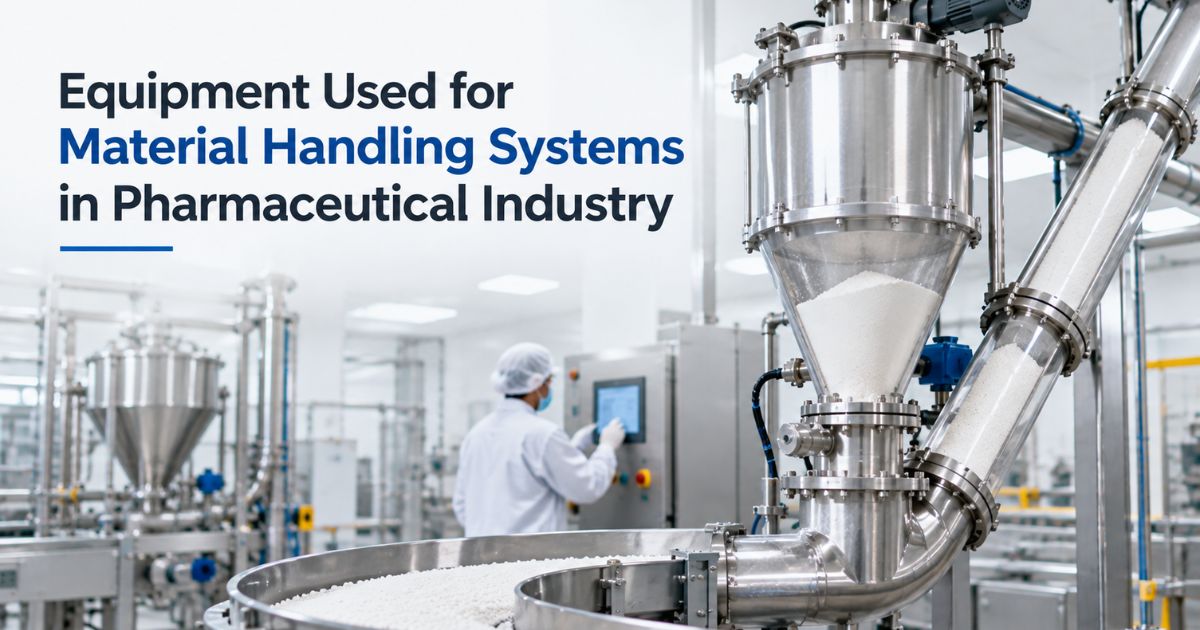
Orchid Material Handling Solutions designs and manufactures material handling systems for pharmaceutical and nutraceutical manufacturing plants, with a focus on hygienic, dust-controlled, accurate and automated movement of powders, granules and bulk solids. In pharmaceutical production, material handling is not simply about moving raw materials from one point to another. Equipment must also support product integrity, controlled material transfer, accurate dosing, operator safety, cleaning requirements and consistent batch processing.
The most commonly used equipment in pharmaceutical material handling systems includes Bag Dischargers, Powder Transfer Systems, Pneumatic Conveying Systems, Screw Conveyors, Mixers & Blenders, IBC Storage & Handling Systems, Silo Storage Systems, Weighing & Batching Systems, Bag Filling Machines, Dust & Air Filtration Systems and PLC/HMI-based Automation Panels. The right combination depends on the material, process stage, batch size, containment requirements, production capacity and plant layout.
This article explains the major equipment used in pharmaceutical material handling, what each system does, and how these technologies can be integrated into a complete powder handling process.
What Is Material Handling in the Pharmaceutical Industry?
Pharmaceutical material handling refers to the controlled movement, storage, feeding, weighing, mixing and transfer of raw materials, intermediates and finished products within a pharmaceutical manufacturing facility.
Materials can include APIs, excipients, powders, granules, active ingredients, nutraceutical ingredients and other formulation components. Because many pharmaceutical materials are fine, sensitive or high-value, conventional manual handling can create challenges related to dust exposure, cross-contamination, product loss, inaccurate dosing and operator safety.
A pharmaceutical material handling system therefore aims to move materials in a controlled, enclosed and repeatable manner, while maintaining the required hygiene and process conditions.
A typical process may look like:
Raw Material Receipt → Bag/Container Unloading → Powder Transfer → Storage → Weighing & Batching → Mixing → Process Transfer → Filling / Packaging
Each stage can use different equipment depending on the manufacturing process.
Key Equipment Used in Pharmaceutical Material Handling
1. Bag Dischargers
Bag Dischargers are used to safely unload powders and granules from bags before the material enters the next stage of the process. Pharmaceutical plants may handle raw materials in small bags as well as FIBC or jumbo bags, making the right unloading arrangement important for both operator safety and material containment.
Orchid Material Handling Solutions provides different bag unloading configurations, including Bulk / Jumbo Bag Unloading Systems, Manual Bag Dumping Stations and Automatic Small Bag Slitting Machines. These systems can incorporate dust-control arrangements and can be connected to downstream conveyors, feeders, mixers or pneumatic conveying systems.
For pharmaceutical applications, bag discharging is often the first point where an enclosed and controlled material handling process can replace repetitive manual material transfer.
2. Powder Transfer Systems
A Powder Transfer System (PTS) is designed for enclosed transfer of powders between containers, process equipment or production areas. It is particularly useful where dust control, contamination prevention and controlled powder handling are important.
Orchid’s Powder Transfer Systems use pneumatic vacuum technology to draw material into a sealed vessel before controlled discharge into the receiving equipment. Depending on the application, systems can include stainless-steel construction, GMP/FDA-oriented configurations, regenerable cartridge filtration, optional HEPA filtration and PLC-driven controls.
These systems can be particularly relevant for pharmaceutical applications involving APIs, excipients, sterile powders and nutraceutical blends.
3. Pneumatic Conveying Systems
Pneumatic conveying systems transport powders and granules through enclosed pipelines using air or vacuum. Compared with open manual transfer, pneumatic conveying can provide a more controlled route for material movement while allowing flexible connections between different process areas.
Orchid offers Dilute Phase Vacuum Conveying Systems and Dilute Phase Pressure Conveying Systems, along with Powder Transfer Systems for specific enclosed transfer applications.
Vacuum conveying can be useful where material needs to be drawn from multiple pickup points or transferred through flexible plant layouts, while pressure conveying can be considered for continuous, higher-capacity or longer-distance material movement.
The appropriate conveying method depends on the material characteristics, required throughput, conveying distance, process configuration and containment requirements.
4. Screw Conveyors
Screw Conveyors use a rotating helical screw to move powders and bulk solids through a trough or enclosed pipe. They are commonly used where controlled mechanical conveying is required over short to medium distances.
Orchid offers U-Trough Screw Conveyors, Pipe / Tubular Screw Conveyors and Mobile or Trolley-Mounted Screw Conveyors. For pharmaceutical applications, enclosed tubular designs can be useful for reducing spillage and uncontrolled material exposure.
Screw conveyors can also be integrated with bag dischargers, silos, mixers, feeders and packaging systems to create a continuous material handling process.
5. Mixers & Blenders
Once raw materials have been transferred and accurately dosed, pharmaceutical manufacturing often requires homogeneous mixing of APIs, excipients or other formulation ingredients.
Industrial mixers and blenders are therefore an important part of the overall material handling system.
Orchid’s mixer portfolio includes Ribbon Blenders, Paddle Mixers, Plough Shear Mixers, Conical Screw Mixers, Double Cone Blenders, V-Blenders and Octagonal Blenders.
The appropriate mixer depends on factors such as powder characteristics, batch size, required mixing uniformity, sensitivity of the product and process requirements.
For pharmaceutical manufacturing, mixer design may also need to consider hygienic construction, cleaning access and integration with upstream and downstream equipment.
6. IBC Storage & Handling Systems
Intermediate Bulk Containers, or IBCs, provide a practical method for storing, transferring and handling pharmaceutical powders and other bulk materials between process stages.
Orchid’s IBC Storage & Handling Systems are available in fixed and mobile configurations and can be integrated with docking, discharge, weighing and blending arrangements. Pharmaceutical applications can use SS304 or SS316L construction with polished internal surfaces and cGMP-oriented configurations.
IBC systems can help reduce repeated manual handling and provide greater flexibility when the same material needs to move between different stages of a batch process.
For facilities requiring additional handling flexibility, Orchid also provides IBC Lifter & Tilter Systems for controlled lifting and tilting of IBC containers.
7. Silo Storage Systems
For larger-volume raw materials, pharmaceutical and nutraceutical plants may use silo-based storage systems instead of smaller containers or bags.
Silo systems can provide enclosed storage and controlled discharge while integrating with weighing, conveying, feeding and dust filtration equipment.
Depending on the material, silo discharge can be supported using flow-assistance equipment such as Bin Activators, which help address flow problems such as bridging, rat-holing and inconsistent powder discharge.
Orchid’s silo solutions can be integrated with material handling equipment such as bin activators, weighing systems, level sensors and bin vent filters to create a more controlled storage and discharge process.
8. Weighing & Batching Systems
Accurate weighing is particularly important in pharmaceutical manufacturing because formulation accuracy directly affects product consistency and batch quality.
Weighing & Batching Systems can automate the measurement and controlled addition of different ingredients according to a predefined recipe.
Depending on the application, the system can integrate:
- Load cells
- Weighing hoppers
- Feeders
- Control panels
- Recipe management
- PLC/HMI controls
- Batch reporting and monitoring
Orchid provides automated weighing and batching solutions designed to integrate with conveying, storage and mixing systems.
The objective is to reduce manual weighing errors while improving batch repeatability and process control.
9. Loss-in-Weight Feeding Systems
Where continuous and highly controlled material feeding is required, a Loss-in-Weight Feeding System can measure material consumption based on the reduction in weight of the feeder or hopper over time.
This approach can be useful for applications requiring controlled and consistent feeding of powders or other bulk materials into a process.
The system can be integrated with upstream storage and downstream processing equipment, depending on the production configuration.
For pharmaceutical and specialty powder applications, accurate feeding can be particularly important where even small variations in ingredient addition can affect the final formulation.
10. Dust & Air Filtration Systems
Dust control is a major consideration in pharmaceutical material handling because many pharmaceutical powders are fine and easily become airborne during unloading, conveying, transfer and filling.
Dust & Air Filtration Systems can help capture airborne particles at material handling points and support a cleaner production environment.
Orchid provides dust-control solutions including Portable Dust Collection Systems, Bin Vent Filters and Dust Collector / Bag Filter Systems. These can be integrated with bag unloading stations, silos, filling systems and other equipment depending on the application.
Effective dust control can help reduce operator exposure, material loss and cleaning requirements while supporting better containment.
11. Bag Filling Machines
At the packaging stage, pharmaceutical powders and granules may need to be transferred into bags or other containers with controlled filling and weighing.
Orchid’s Bag Filling Systems include Valve Bag Filling Machines, Jumbo Bag Filling Machines and Small Bag Filling Machines. The systems can incorporate weighing controls, dust-control arrangements and PLC/HMI automation.
For pharmaceutical applications, filling equipment can be configured around the required bag size, material characteristics, filling accuracy and hygiene requirements.
12. PLC & HMI-Based Control Panels
Automation provides the control layer that connects individual pieces of material handling equipment into a coordinated process.
PLC & HMI-based Control Panels can control equipment such as conveyors, feeders, mixers, filling machines, pneumatic conveying systems and weighing systems.
The HMI can provide operators with visibility into process status, alarms, batch parameters and equipment operation, while the PLC manages the programmed sequence.
Orchid’s automation solutions can also support SCADA integration and process monitoring where required.
For pharmaceutical manufacturing, automation can help improve process repeatability, reduce manual intervention and create better control over material movement and batch operations.
How Pharmaceutical Material Handling Equipment Works Together
The real value of pharmaceutical material handling equipment comes from system integration. Individual machines can perform specific functions, but the overall process becomes more efficient when unloading, conveying, storage, weighing, mixing and packaging are designed to work together.
For example, a powder handling process could follow this sequence:
Bag Discharger → Powder Transfer System → IBC / Silo Storage → Weighing & Batching → Mixer / Blender → Pneumatic Conveying → Bag Filling System
In another application, an IBC-based process may look like:
IBC Storage → IBC Lifter & Tilter → Powder Transfer → Mixer → Filling / Packaging
The actual configuration depends on the formulation process, material characteristics, batch size and plant layout.
This integrated approach is one of the areas where an experienced material handling manufacturer such as Orchid Material Handling Solutions can add value, because equipment selection can be considered at the system level rather than as separate machines.
Why Hygienic Design Matters in Pharmaceutical Material Handling
Pharmaceutical materials require a higher level of process control than many conventional bulk handling applications.
The equipment may need to address concerns such as:
- Cross-contamination
- Product exposure
- Dust generation
- Cleaning requirements
- Material retention
- Batch traceability
- Operator safety
- Controlled material transfer
For this reason, pharmaceutical material handling equipment may use stainless-steel construction, polished product-contact surfaces, enclosed transfer paths and application-specific hygienic configurations.
Orchid provides equipment configurations using SS304 and SS316L, along with GMP-oriented and other application-specific designs depending on the equipment and process requirements.
The exact construction, finish and cleaning provisions should be selected according to the pharmaceutical process and applicable plant requirements.
What Should You Consider When Selecting Pharmaceutical Material Handling Equipment?
Choosing equipment should begin with the material and process rather than the machine name.
Material Characteristics
Understand the material’s particle size, bulk density, flowability, moisture sensitivity, cohesiveness, abrasiveness and sensitivity to shear or mechanical handling.
Required Capacity
Determine whether the process is batch-based or continuous and establish the required throughput in kg/hr, tonnes/hr or batch size.
Containment Requirements
Evaluate whether the material requires enclosed transfer, dust extraction, negative-pressure conveying, sealed connections or additional containment provisions.
Hygiene and Cleaning
Consider product-contact materials, surface finish, cleaning access, dismantling requirements and whether CIP/SIP or other cleaning provisions are required.
Accuracy
For weighing, batching, feeding and filling applications, define the required accuracy before selecting the equipment.
Plant Layout
Available space, elevation differences, transfer distances and access for maintenance can influence whether pneumatic, mechanical, IBC-based or silo-based handling is most appropriate.
Automation
Determine the required level of automation, including PLC/HMI controls, recipe management, alarms, batch records, interlocks and SCADA connectivity.
Pharmaceutical Material Handling Equipment: Quick Reference
| Equipment | Primary Function | Typical Pharmaceutical Application |
| Bag Discharger | Bag unloading | Raw material unloading |
| Powder Transfer System | Enclosed powder transfer | API and excipient transfer |
| Pneumatic Conveying System | Powder/granule transfer | Inter-process conveying |
| Screw Conveyor | Mechanical conveying | Controlled powder transfer |
| IBC Storage System | Bulk storage and transfer | Batch material handling |
| IBC Lifter & Tilter | IBC handling | Controlled discharge |
| Silo Storage System | Bulk storage | High-volume raw materials |
| Bin Activator | Flow assistance | Difficult-flow powders |
| Weighing & Batching System | Accurate dosing | Formulation and batching |
| Loss-in-Weight Feeder | Controlled feeding | Continuous powder feeding |
| Mixer / Blender | Homogeneous mixing | API/excipient blending |
| Dust Collection System | Dust control | Unloading and transfer points |
| Bag Filling Machine | Product packaging | Powder/granule filling |
| PLC & HMI Panel | Process automation | Integrated equipment control |
Common Challenges in Pharmaceutical Material Handling
Pharmaceutical plants can face several challenges when material handling systems rely heavily on manual operations or poorly integrated equipment.
Dust generation can occur during bag unloading, transfer and filling. Cross-contamination risks can increase when materials are exposed during manual handling or when equipment is difficult to clean. Inaccurate dosing can affect formulation consistency, while repeated manual movement can increase operator workload and material spillage.
Another common challenge is fragmented equipment integration. If the bag discharger, conveying system, storage vessel, weighing system and mixer operate independently, operators may need to manually coordinate multiple process steps.
An integrated material handling system can reduce these gaps by connecting the individual stages into a controlled process.
Why Choose Orchid Material Handling Solutions for Pharmaceutical Material Handling?
Orchid Material Handling Solutions brings 18+ years of experience in material and bulk handling systems and designs customized solutions for pharmaceutical and nutraceutical applications.
The company’s pharmaceutical material handling portfolio covers raw material unloading, powder transfer, pneumatic conveying, mechanical conveying, storage, weighing, batching, mixing, dust control, filling and automation.
Orchid’s approach is to understand the complete process before recommending equipment. This allows systems to be designed around material characteristics, production capacity, hygiene requirements, containment needs, plant layout and downstream integration.
From a single Powder Transfer System to a complete automated material handling line, equipment can be configured to support safer, cleaner and more consistent pharmaceutical manufacturing.
[Explore Pharmaceutical & Nutraceutical Material Handling Solutions]
Frequently Asked Questions
Common pharmaceutical material handling equipment includes Bag Dischargers, Powder Transfer Systems, Pneumatic Conveying Systems, Screw Conveyors, IBC Storage & Handling Systems, Silo Storage Systems, Weighing & Batching Systems, Mixers & Blenders, Dust Collection Systems, Bag Filling Machines and PLC/HMI-based Automation Panels.
There is no single equipment type that is best for every pharmaceutical powder. Powder Transfer Systems and pneumatic conveying systems are commonly considered when enclosed and controlled transfer is required, while screw conveyors and other mechanical conveyors may be suitable for specific process conditions.
Pneumatic conveying provides an enclosed method of transporting powders and granules through pipelines. It can help reduce manual handling and material exposure while allowing flexible routing between process equipment.
A Powder Transfer System is an enclosed pneumatic system used to transfer powders between containers, process equipment or production areas. Orchid’s Powder Transfer Systems use vacuum-based transfer with sealed vessels and can be configured with stainless-steel construction, filtration and automation options.
Depending on the production volume and process, pharmaceutical powders can be stored in IBCs, bins, hoppers or silos. IBC systems are useful for flexible batch handling, while silo systems are more suitable for larger-volume bulk storage.
SS304 and SS316L are commonly considered for pharmaceutical applications because they support hygienic equipment construction and can be selected according to product-contact, cleaning and corrosion-resistance requirements.
Dust can be controlled through enclosed transfer systems, dust extraction, filtration, sealed connections and appropriate equipment design. Orchid provides dust collection and filtration solutions that can be integrated with unloading, storage, conveying and filling equipment.
Yes. Equipment such as conveyors, feeders, weighing systems, mixers, pneumatic conveying systems and filling machines can be integrated with PLC/HMI-based automation. Automation can support process sequencing, recipe management, alarms, monitoring and reduced manual intervention.
Selection should consider the material characteristics, required capacity, batch size, conveying distance, hygiene requirements, containment needs, cleaning process, accuracy, plant layout and required level of automation. A complete process assessment is generally more effective than selecting each machine independently.
Conclusion
Material handling is an important part of pharmaceutical manufacturing because the way raw materials are unloaded, transferred, stored, weighed, mixed and filled can directly influence process efficiency, product integrity and operator safety.
Equipment such as Bag Dischargers, Powder Transfer Systems, Pneumatic Conveying Systems, Screw Conveyors, IBC Systems, Silo Storage Systems, Weighing & Batching Systems, Mixers, Dust Collection Systems, Filling Machines and Automation Panels can each perform a specific role within the manufacturing process.
The most effective pharmaceutical material handling setup is not necessarily the one with the largest number of machines. It is the one where each piece of equipment is appropriately selected and integrated around the material, process and plant requirements.
Orchid Material Handling Solutions provides customized pharmaceutical and nutraceutical material handling systems covering powder transfer, conveying, storage, batching, mixing, filling and automation.
Looking to improve material handling in your pharmaceutical manufacturing plant?
Connect with Orchid Material Handling Solutions to discuss your material characteristics, process requirements, production capacity and hygiene or containment needs.