- sales@orchidmhs.com
- +91 9322487698
- +91 7028807698
- ISO 9001:2015

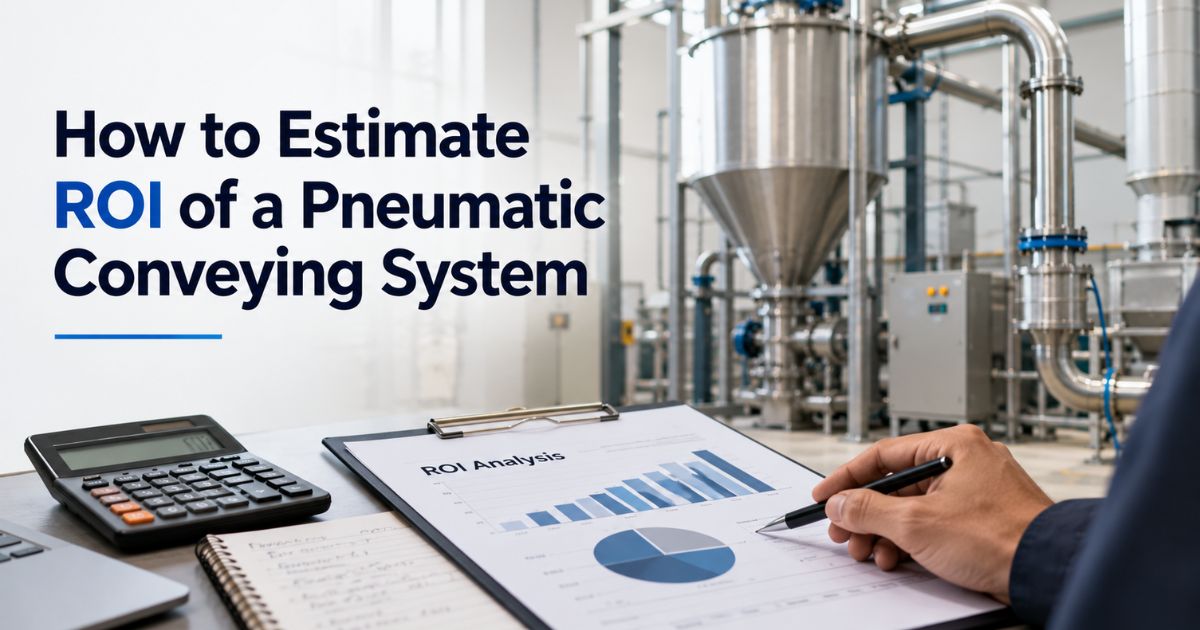
How to Estimate ROI of a Pneumatic Conveying System
10 Oct 2026
Orchid Material Handling Solutions designs and manufactures pneumatic conveying systems that help industries automate the transfer of powders, granules and bulk solids while improving material handling efficiency, hygiene and process reliability.
But when a plant is evaluating a new Pneumatic Conveying System, one of the most important questions is not only “Will it work?” but also “What will the return on investment look like?”
A pneumatic conveying system involves an upfront investment in equipment, engineering, installation and integration. At the same time, it can influence several operating costs, including manual material handling, product losses, cleaning requirements, downtime, labour requirements and production efficiency.
Estimating ROI therefore requires looking beyond the equipment purchase price and evaluating the total cost of ownership against the measurable operational benefits.
In this guide, we explain how manufacturers can build a practical ROI calculation for a pneumatic conveying system.
What Does ROI Mean for a Pneumatic Conveying System?
Return on Investment (ROI) measures the financial benefit generated by an investment compared with the cost of making that investment.
A simple ROI calculation is:
ROI (%) = (Annual Financial Benefit – Annual Operating Cost) ÷ Initial Investment × 100
For a pneumatic conveying system, however, the calculation should be based on the actual operating conditions of the plant.
Depending on the application, the financial benefits may come from:
- Reduced manual handling
- Lower labour requirements
- Reduced material loss
- Lower cleaning and housekeeping costs
- Improved production throughput
- Reduced product contamination
- Lower downtime
- Better process consistency
- Reduced maintenance requirements
- Improved utilization of production equipment
The exact benefits will vary depending on the existing material handling process and the proposed system configuration.
Step 1: Calculate the Initial Investment
The first step is to determine the complete installed cost rather than considering only the price of the pneumatic conveying equipment.
For a project from Orchid Material Handling Solutions, the initial investment may include:
- Pneumatic conveying equipment
- Blower, vacuum pump or other air-generation equipment
- Conveying pipeline
- Feeders and rotary airlocks
- Filters and dust-control equipment
- Receiving equipment
- Control panel and automation
- Structural supports
- Electrical work
- Installation and commissioning
- Integration with existing equipment
- Engineering and customization
For example, a Powder Transfer System may have a different investment structure from a continuous Dilute Phase Pressure Conveying System or Dilute Phase Vacuum Conveying System.
This is why comparing systems purely on equipment price can give an incomplete picture.
Step 2: Understand the Existing Material Handling Cost
Before calculating savings, establish what the current process is costing the plant.
Consider how material currently moves from one point to another.
For example:
Bag Unloading → Manual Transfer → Intermediate Handling → Process Equipment
versus:
Auto Bag Discharger → Pneumatic Conveying → Process Equipment
The existing process may involve several direct and indirect costs.
Labour Cost
Calculate the number of employees involved in:
- Bag unloading
- Material transfer
- Manual feeding
- Intermediate handling
- Cleaning
- Material movement
Then calculate the annual labour cost associated with these activities.
The objective is not necessarily to eliminate manpower, but to determine how much manual effort can realistically be reduced or redirected to higher-value activities.
Material Loss
Small losses during manual transfer can accumulate over time.
Estimate:
Annual Material Loss = Material Handled × Loss Percentage × Material Cost
For high-value powders, pharmaceutical ingredients, specialty chemicals or additives, even a relatively small reduction in material loss can have a measurable financial impact.
Cleaning and Housekeeping
Open material transfer can create additional cleaning requirements.
Consider:
- Cleaning labour
- Production downtime for cleaning
- Material recovery
- Waste disposal
- Housekeeping requirements
An enclosed pneumatic conveying system can help reduce material exposure and dust generation when appropriately designed.
Orchid’s pneumatic conveying systems are designed for enclosed, dust-controlled transfer of powders and bulk solids.
Step 3: Estimate the Production Benefit
ROI should not be calculated only from labour savings.
A properly integrated pneumatic conveying system can also influence production efficiency.
Consider:
- Current material transfer rate
- Proposed conveying capacity
- Loading and unloading time
- Production cycle time
- Equipment utilization
- Frequency of material interruptions
- Manual feeding delays
For example, if manual transfer requires operators to periodically feed material into a process, the production line may experience interruptions.
Automated conveying can help provide a more consistent material supply to downstream equipment.
The financial value should be calculated using the actual additional production capacity or reduced downtime, rather than assuming that every theoretical increase in conveying capacity becomes additional revenue.
Step 4: Calculate Energy Consumption
Energy consumption is an important part of pneumatic conveying ROI.
The major energy-consuming components may include:
- Blowers
- Vacuum pumps
- Compressors, where applicable
- Rotary airlocks
- Feeders
- Motors
- Dust collection equipment
- Automation and auxiliary equipment
Estimate the annual electrical cost using:
Annual Energy Cost = Power Consumption (kW) × Operating Hours × Electricity Cost per kWh
For example, if a conveying system operates at an average electrical load of 25 kW for 4,000 hours per year:
25 × 4,000 = 100,000 kWh/year
The actual annual energy cost can then be calculated using the plant’s electricity tariff.
This is why system design matters. Airflow, conveying pressure, material characteristics, pipeline routing and throughput all influence the operating requirements of a pneumatic conveying system.
Step 5: Include Maintenance Costs
Maintenance should be included in the ROI calculation because pneumatic conveying systems contain several operating components.
Consider the expected cost of:
- Filters
- Rotary valves
- Seals
- Bearings
- Blower maintenance
- Vacuum equipment
- Pipeline wear components
- Instrumentation
- Electrical and control components
At the same time, compare these costs with the maintenance requirements of the existing material handling process.
A pneumatic system may introduce new maintenance requirements while reducing certain manual handling and mechanical transfer activities.
The correct comparison is therefore:
Existing Process Maintenance Cost vs. New System Maintenance Cost
rather than assuming that the new system has zero maintenance requirements.
Step 6: Calculate Annual Financial Benefits
Once the individual savings have been estimated, combine them into an annual benefit model.
A simple structure could look like this:
| Benefit Area | Existing Annual Cost | Expected New Cost | Annual Saving |
| Manual Handling | ₹X | ₹Y | ₹X-Y |
| Material Loss | ₹X | ₹Y | ₹X-Y |
| Cleaning & Housekeeping | ₹X | ₹Y | ₹X-Y |
| Downtime | ₹X | ₹Y | ₹X-Y |
| Maintenance | ₹X | ₹Y | ₹X-Y |
| Energy | ₹X | ₹Y | ₹X-Y |
| Total | Annual Benefit |
The numbers should be based on actual plant data wherever possible.
This creates a more realistic business case than using a standard ROI percentage for every pneumatic conveying application.
Step 7: Calculate the Payback Period
Payback period is often one of the most useful metrics for plant management.
A simplified calculation is:
Payback Period = Initial Investment ÷ Annual Net Financial Benefit
For example, if:
- Initial investment = ₹50 lakh
- Annual financial benefit = ₹12.5 lakh
Then:
Payback Period = ₹50 lakh ÷ ₹12.5 lakh = 4 years
This is only an illustrative calculation. Actual payback depends on the equipment configuration, operating hours, labour cost, material value, throughput, energy consumption and other plant-specific factors.
Step 8: Consider the Cost of Downtime
Downtime can sometimes have a larger financial impact than direct labour or energy savings.
If manual material handling causes production interruptions, calculate:
Downtime Cost = Lost Production × Contribution Margin per Unit
Then estimate how much of this downtime could realistically be reduced through automated conveying.
This is particularly relevant for continuous manufacturing processes where material availability directly affects production.
For applications involving continuous, high-volume transfer, Orchid’s Dilute Phase Pressure Conveying Systems are designed for large-volume and long-distance material transfer.
Step 9: Account for Product Quality and Material Loss
ROI is not always limited to direct cost savings.
A pneumatic conveying system can also create financial value through more controlled material handling.
Depending on the application, benefits may include:
- Reduced exposure to contaminants
- Reduced dust generation
- Better containment
- Consistent material transfer
- Reduced manual contact
- Lower product spillage
- Improved process repeatability
For pharmaceutical, food, chemical and other controlled applications, these factors can be particularly important.
Orchid’s Powder Transfer Systems are designed for enclosed and automated powder transfer, with configurations supporting controlled environments and applications where hygiene and contamination control are important.
Step 10: Compare Different Pneumatic Conveying Configurations
Not every pneumatic conveying system will have the same ROI.
For example, Orchid offers different conveying approaches depending on application requirements.
Powder Transfer System
A Powder Transfer System (PTS) can be suitable for controlled, enclosed transfer of powders between containers, process equipment or cleanroom environments.
The ROI calculation should consider reduced manual handling, material containment, cleaning effort and process integration.
Dilute Phase Vacuum Conveying System
A Dilute Phase Vacuum Conveying System uses negative pressure to transfer powders and granules through a pipeline.
It can be considered for applications requiring flexible routing, multi-point feeding and enclosed material transfer.
Dilute Phase Pressure Conveying System
A Dilute Phase Pressure Conveying System uses positive-pressure air to transfer powders and granules and can be suited to long-distance and high-capacity conveying applications.
The ROI model should therefore account for the required conveying distance, throughput, energy demand and integration requirements.
The right configuration should be selected according to the material and process rather than selecting a system purely because its initial purchase price is lower.
What Information Do You Need to Estimate ROI?
A realistic ROI assessment starts with reliable operating data.
For an existing or proposed pneumatic conveying project, the following information is useful:
Material Information
- Material name
- Bulk density
- Particle size
- Material flowability
- Moisture sensitivity
- Abrasiveness
- Fragility
- Temperature sensitivity
Process Information
- Required throughput
- Operating hours per day
- Operating days per year
- Conveying distance
- Vertical lift
- Number of pickup and discharge points
- Existing equipment
- Required automation level
Cost Information
- Current labour cost
- Electricity tariff
- Material cost
- Current material losses
- Cleaning cost
- Maintenance cost
- Downtime cost
- Existing equipment operating cost
With these inputs, the expected capital cost and operating benefits can be evaluated more realistically.
Example ROI Calculation for a Pneumatic Conveying System
Consider a manufacturing plant currently using manual material transfer.
Suppose the estimated annual costs are:
| Cost Component | Current Annual Cost |
| Manual Material Handling | ₹10 lakh |
| Material Loss | ₹4 lakh |
| Cleaning & Housekeeping | ₹2 lakh |
| Downtime / Handling Delays | ₹5 lakh |
| Energy & Other Operating Costs | ₹2 lakh |
| Total | ₹23 lakh |
After implementing an automated pneumatic conveying system, suppose the estimated annual operating benefit is ₹12 lakh after accounting for the new system’s energy and maintenance costs.
If the total installed project investment is ₹48 lakh:
Payback Period = ₹48 lakh ÷ ₹12 lakh = 4 years
The example demonstrates the calculation method rather than a guaranteed project outcome.
Actual ROI should be calculated using plant-specific operating data and a confirmed system configuration.
Factors That Can Improve Pneumatic Conveying ROI
Several design decisions can influence the long-term financial performance of the system.
1. Correct System Sizing
Avoid unnecessarily oversized equipment and ensure the system matches the actual throughput requirement.
2. Efficient Pipeline Design
Pipeline diameter, routing, bends and conveying distance can influence pressure losses and energy requirements.
3. Appropriate Conveying Method
The choice between vacuum, pressure, dilute phase or another conveying configuration should be based on material and process requirements.
4. Integration With Existing Equipment
Connecting the pneumatic conveying system with bag dischargers, feeders, mixers, silos, weighing systems and filling equipment can reduce intermediate handling.
5. Automation
PLC and HMI-based controls can help coordinate conveying, feeding and downstream process operations.
6. Preventive Maintenance
Maintaining filters, blowers, valves, seals and instrumentation helps maintain stable system performance over its operating life.
Why Work With an Engineering-Led Pneumatic Conveying Manufacturer?
ROI depends heavily on how well the system is matched to the actual process.
Orchid Material Handling Solutions brings 18+ years of experience in material and bulk handling and provides customized systems for powders, granules and bulk solids across industries including pharmaceuticals, food and beverages, chemicals, plastics, agriculture and minerals.
Instead of evaluating pneumatic conveying only as an individual machine, Orchid approaches it as part of the wider material handling process.
This can include:
Bag Discharging → Feeding → Pneumatic Conveying → Storage → Mixing → Weighing → Filling
By considering the complete process, the system can be engineered around throughput, material characteristics, dust control, automation, integration and operating requirements.
FAQs
Start by calculating the complete installed investment and comparing it with annual net financial benefits such as labour savings, reduced material loss, lower cleaning costs, reduced downtime and other measurable operational improvements.
The most important factor is using realistic plant-specific data. Throughput, operating hours, labour costs, material value, electricity consumption, downtime and existing handling costs can significantly influence the final ROI.
It can reduce manual material handling requirements by automating the transfer of powders and bulk solids. The actual labour saving depends on the existing process and how the new system is integrated.
Energy consumption depends on the conveying method, material, throughput, distance, pipeline configuration, airflow and pressure requirements. Proper system sizing and engineering can help avoid unnecessary energy consumption.
An enclosed conveying system can reduce spillage and uncontrolled material exposure compared with certain open manual transfer methods. The actual reduction depends on the existing process and system design.
No. ROI varies significantly based on material value, production volume, operating hours, labour cost, energy cost, conveying distance, system configuration and the benefits generated by automation.
Useful information includes material type, bulk density, required throughput, conveying distance, pickup and discharge points, operating hours, existing handling method and downstream equipment. Orchid can use these inputs to evaluate the appropriate pneumatic conveying configuration.
Conclusion
Our Orchid Material Handling System Provides this information to everyone who wants to automate their plant but they have to think about ROI also. We provide solutions with the benefit of equipment everyone should know before purchase. Estimating the ROI of a pneumatic conveying system requires more than comparing the equipment purchase price with expected savings.
A proper evaluation should consider capital investment, labour, energy, material loss, maintenance, cleaning, downtime, production efficiency and process integration.
The right pneumatic conveying system can deliver value not only through automation but also through more controlled, enclosed and consistent material handling.
For manufacturers considering a new Pneumatic Conveying System, Powder Transfer System, Dilute Phase Vacuum Conveying System or Dilute Phase Pressure Conveying System, an application-specific ROI assessment can provide a clearer picture of the investment and its long-term operating impact.
Looking to evaluate the ROI of a pneumatic conveying system for your plant?
Connect with Orchid Material Handling Solutions to discuss your material, throughput, conveying distance, existing process and automation requirements.