- sales@orchidmhs.com
- +91 9322487698
- +91 7028807698
- ISO 9001:2015


Types of Materials Best Suited for Pneumatic Conveying
23 Apr 2026
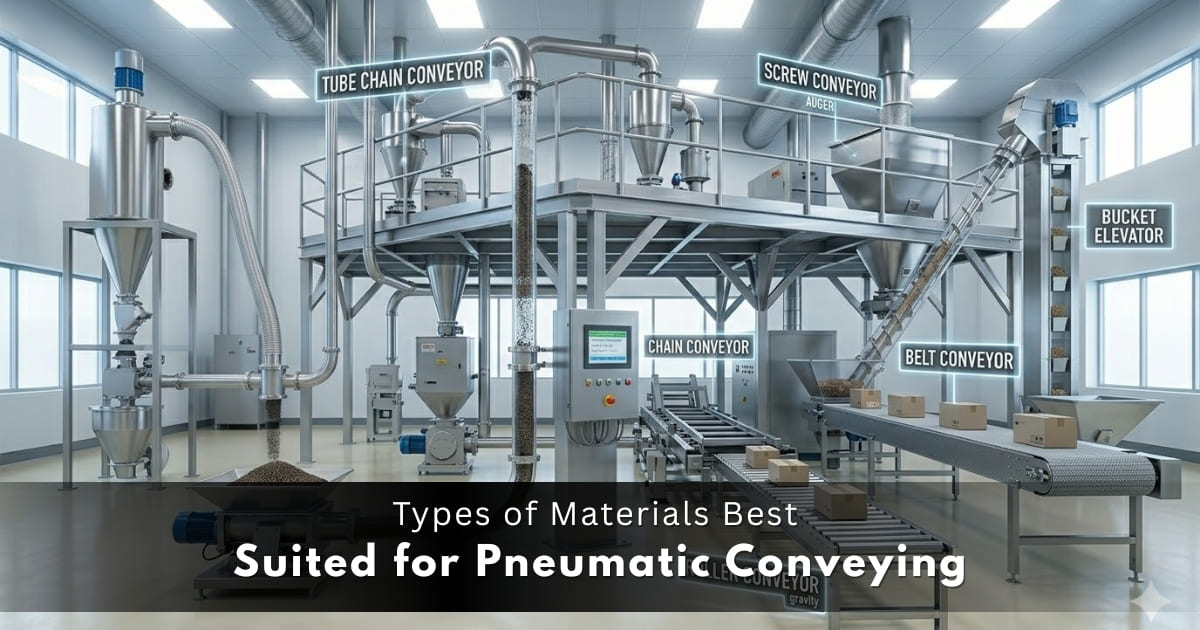
Not every material behaves well in a conveying system – and that’s exactly where many plants lose efficiency. Blockages, material degradation, dust issues, or inconsistent flow often come down to one thing: wrong system for the material.
Pneumatic conveying stands out because it handles fine, lightweight, and sensitive materials in a sealed, controlled environment. But the real question isn’t “what is pneumatic conveying?” – it’s “which materials actually perform best with it?”
In practice, plants working with engineered solutions from Orchid Material Handling Solutions often evaluate material characteristics first, and only then finalize the conveying method. That’s where the real optimization begins.
Orchid material handling manufactures all types of pneumatic conveying systems. Also we provide consultation to select suitable pneumatic conveying systems as per material nature.
What Makes a Material Suitable for Pneumatic Conveying?
Before jumping into material types, it’s important to understand what actually defines compatibility. Pneumatic conveying works best when materials:
- Are fine or granular in nature
- Have low to moderate bulk density
- Can be fluidized or carried by airflow
- Are non-sticky and free-flowing
- Require dust-free or enclosed handling
When these conditions are met, pneumatic systems deliver consistent flow, minimal loss, and high process efficiency.
Materials That Perform Best in Pneumatic Conveying Systems
Instead of listing random categories, let’s break this down the way plants actually evaluate materials – by behavior and handling requirements.
Fine Powders (Most Ideal Category)
Materials in powder form are the most suitable for pneumatic conveying because they can be easily transported through airflow.
Examples:
- Flour, starch, milk powder
- Cement, fly ash
- Talc, silica
Why they work well:
- Easily fluidized
- Smooth pipeline movement
- Minimal mechanical handling required
In industries like food and cement, pneumatic conveying becomes the default choice for these materials.
Lightweight Granules
Granular materials with lower density also perform efficiently in pneumatic systems, especially in controlled environments.
Examples:
- Plastic resins and pellets
- Sugar and salt
- Fertilizer granules
Why they work well:
- Stable flow characteristics
- Reduced risk of pipeline blockage
- Consistent transfer over long distances
Fragile & Degradation-Sensitive Materials
Some materials cannot withstand mechanical handling due to breakage or quality loss. Pneumatic systems provide a gentler transfer mechanism when designed correctly.
Examples:
- Food flakes and crystals
- Specialty chemicals
- Nutraceutical ingredients
Why they work well:
- Reduced mechanical stress
- Controlled velocity (especially in dense phase systems)
- Maintains product integrity
Dust-Prone and Hazardous Materials
For materials that create dust or pose safety risks, enclosed pneumatic conveying systems are often the safest option.
Examples:
- Chemical powders
- Carbon black
- Pharmaceutical ingredients
Why they work well:
- Fully enclosed system prevents exposure
- Reduces contamination and environmental risks
- Improves workplace safety
Bulk Industrial Powders
Large-scale industries dealing with high volumes benefit significantly from pneumatic conveying.
Examples:
- Cement and clinker dust
- Lime and gypsum
- Ash handling in power plants
Why they work well:
- Efficient long-distance transport
- Reduced spillage and loss
- Suitable for continuous operations
Materials That Require Careful Evaluation
Not all materials are a perfect fit. Some can still be conveyed pneumatically – but only with the right system design.
Sticky or Cohesive Materials
- Tend to clog pipelines
- Require specialized systems or additives
Abrasive Materials
- Cause wear in pipelines
- Need reinforced components
High-Density Materials
- Require higher energy input
- Better suited for dense phase systems
This is where system design becomes critical – not just selection.
Matching Material Type with Conveying Method
| Material Type | Recommended Approach |
| Fine powders | Dilute phase pneumatic conveying |
| Fragile materials | Dense phase conveying |
| Dust-prone materials | Vacuum conveying |
| Bulk industrial powders | Pressure conveying |
| Granules | Either dilute or dense phase (based on flow behavior) |
Why Pneumatic Conveying Works So Well for These Materials
The advantage isn’t just movement – it’s control.
Enclosed & Dust-Free Transfer
Ideal for industries where hygiene and safety are non-negotiable
Consistent Material Flow
Reduces interruptions and improves production efficiency
Minimal Material Loss
Prevents spillage and airborne waste
Flexible Plant Integration
Easily adapts to complex layouts without multiple transfer points
How to Decide if Your Material is Suitable
In real-world operations, selection is rarely based on one factor. It comes down to a combination of:
- Particle size and shape
- Bulk density
- Moisture content
- Flow behavior
- Distance and routing requirements
This is why many manufacturers prefer working with solution providers like Orchid Material Handling Solutions, where system design is aligned with actual material behavior and plant conditions, rather than a one-size-fits-all approach.
Final Thoughts
Pneumatic conveying is highly effective – but only when the material is right for it. Fine powders, lightweight granules, and dust-sensitive materials typically deliver the best results, while others require more tailored system design.
The real efficiency gain comes from matching the material with the right conveying approach, ensuring smoother operations, reduced losses, and better long-term performance.
You can connect with us for your queries. Mail id – sales@orchidmhs.com | Website – https://www.orchidmaterialhandling.com/contact-us/ | contact no. +91 9322487698 | Social– facebook, linkedin
FAQs
Fine powders, lightweight granules, and dust-prone materials are the most suitable.
Yes, but they usually require dense phase systems and higher energy input.
Yes, it is widely used due to its dust-free and hygienic operation.
Highly sticky, very abrasive, or extremely dense materials may require special system design