- sales@orchidmhs.com
- +91 9322487698
- +91 7028807698
- ISO 9001:2015


Screw Conveyors: Types, Components and Configurations Explained
06 Feb 2026
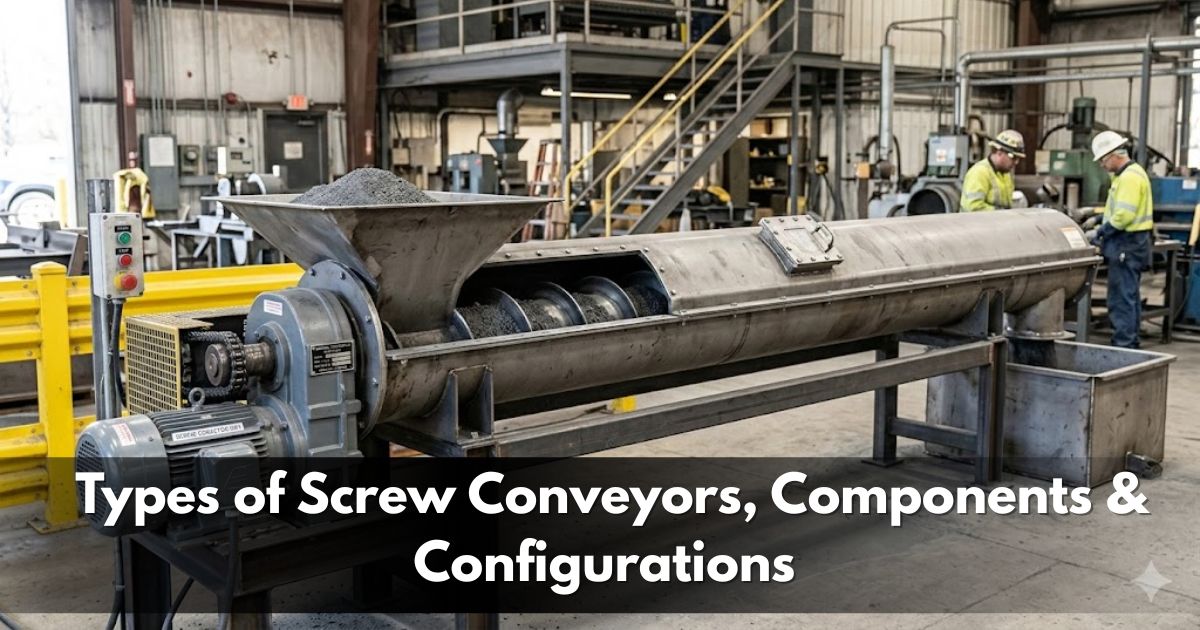
Screw conveyors are one of the most widely used bulk material handling solutions across industries. Their simple design, controlled material movement, and ability to handle a wide range of bulk materials make them an essential part of many processing and manufacturing systems.
From powders and granules to semi-solid materials, screw conveyors are used wherever precise, enclosed, and reliable material transfer is required. However, not all screw conveyors are the same. Their performance depends heavily on the type of screw, internal components, and system configuration.
This guide explains screw conveyors in a structured way, covering their types, key components, and common configurations to help industries choose the right design for their application.
What Is a Screw Conveyor
A screw conveyor is a mechanical conveying system that moves material using a rotating helical screw, also known as a flight, inside a trough or tubular casing. As the screw rotates, material is pushed forward along the length of the conveyor.
Screw conveyors are particularly effective for short to medium-distance conveying where controlled feed, containment, and minimal spillage are required.
They are commonly used in industries such as food processing, chemicals, pharmaceuticals, cement, plastics, and agriculture.
How Screw Conveyors Work
The working principle of a screw conveyor is based on rotational motion and friction. When the screw rotates, material resting in the trough moves forward due to friction between the material and the screw flight.
The casing prevents the material from rotating with the screw, allowing forward movement instead. The speed of rotation, pitch of the screw, and material properties determine the conveying rate.
This simple yet effective mechanism allows screw conveyors to handle a wide range of materials consistently.
Key Components of a Screw Conveyor
Understanding the main components helps in selecting and maintaining the right system.
Screw Flight (Helical Blade)
The screw flight is the primary moving component. It is responsible for pushing material along the conveyor. Flights vary in pitch, thickness, and design depending on application.
Shaft
The shaft runs through the center of the screw flight and transmits torque from the drive unit. In some designs, shaftless configurations are also used.
Trough or Casing
The trough or casing houses the screw and material. It may be U-shaped, tubular, or rectangular depending on containment and material requirements.
Drive Unit
The drive unit consists of a motor and gearbox that control screw speed and torque. Proper drive selection ensures efficient conveying without overloading.
Bearings and Seals
Bearings support the rotating shaft, while seals prevent material leakage and contamination. Their selection is critical for abrasive or hygienic applications.
Types of Screw Conveyors
Screw conveyors are available in several types, each designed for specific handling needs.
1. Horizontal Screw Conveyors
These are the most common type and are used for moving materials horizontally.
Best suited for:
Free-flowing and semi-free-flowing materials over short distances.
2. Inclined Screw Conveyors
Inclined screw conveyors move material at an upward angle.
Key consideration:
As the incline increases, conveying efficiency decreases, requiring higher power and modified screw designs.
Best suited for:
Feeding material to elevated equipment where space is limited.
3. Vertical Screw Conveyors
Vertical screw conveyors move materials straight up.
Best suited for:
Applications requiring vertical lifting of bulk materials with minimal footprint.
4. Shafted Screw Conveyors
These conveyors include a central shaft and are the most commonly used design.
Best suited for:
Dry, free-flowing, and non-sticky materials.
5. Shaftless Screw Conveyors
Shaftless screw conveyors eliminate the central shaft, allowing the screw to rotate freely.
Best suited for:
Sticky, viscous, or fibrous materials that tend to wrap around shafts.
Screw Flight Types and Their Uses
The design of the screw flight significantly affects material flow.
| Flight Type | Description | Typical Use |
| Standard Pitch | Uniform spacing | General-purpose conveying |
| Short Pitch | Reduced spacing | Inclined conveying |
| Variable Pitch | Changing spacing | Controlled feeding |
| Ribbon Flight | Open design | Sticky materials |
| Paddle Flight | Mixing action | Blending and agitation |
Selecting the right flight type ensures smooth material flow and reduces wear.
Common Screw Conveyor Configurations
Screw conveyors can be configured to match specific process needs.
Single Screw Configuration
Used for standard conveying applications with moderate capacity.
Twin Screw Configuration
Uses two intermeshing screws.
Benefits:
Improved mixing, higher capacity, and better handling of difficult materials.
Enclosed Screw Conveyors
Fully enclosed systems that prevent dust escape and contamination.
Used in:
Food, pharmaceutical, and chemical industries.
Open Trough Screw Conveyors
Allow easy inspection and maintenance.
Used in:
Applications where dust control is not critical.
Applications of Screw Conveyors Across Industries
Screw conveyors are used in a wide range of industries due to their versatility.
- Food processing: Flour, sugar, spices, grains
- Pharmaceuticals: Powders, intermediates
- Chemicals: Fine powders, additives
- Cement and minerals: Cement, fly ash, limestone
- Agriculture: Seeds, grains, fertilizers
Each application requires careful selection of materials, sealing, and configuration.
Advantages of Screw Conveyors
- Compact and space-efficient
- Enclosed and dust-controlled operation
- Accurate and controlled material feeding
- Simple mechanical design
- Easy integration with other equipment
Limitations to Consider
- Not ideal for long-distance conveying
- Can cause material degradation for fragile products
- Higher wear for abrasive materials
- Limited capacity compared to belt conveyors
Understanding these limitations prevents misuse of the system.
How to Choose the Right Screw Conveyor
Before finalizing a screw conveyor, consider:
- Material properties and flow behavior
- Required capacity and conveying distance
- Incline or vertical movement needs
- Hygiene and containment requirements
- Maintenance access and operating conditions
Engineering-focused solution providers like Orchid Material Handling typically customize screw conveyor designs based on real process requirements rather than standard assumptions.
Conclusion
Screw conveyors are a reliable and versatile solution for controlled bulk material handling. Their effectiveness depends on selecting the right type, components, and configuration for the material and process involved.
When designed correctly, screw conveyors deliver consistent performance, reduced material loss, and smooth integration into industrial workflows. Understanding their design options allows industries to maximize efficiency while avoiding common operational challenges.